


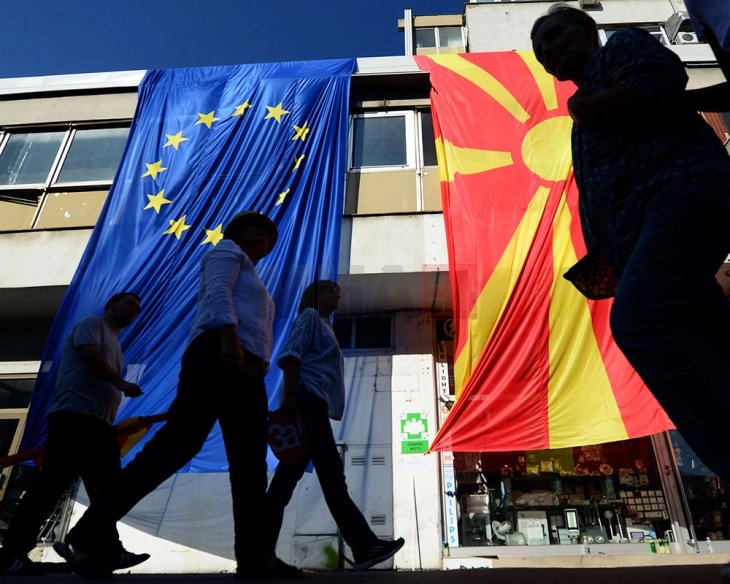
Skopje – Support for North Macedonia’s accession to the European Union remains robust at 62 percent, although younger and older demographics exhibit more caution and indecisiveness regarding the issue. Additionally, public perception of the United States’ influence has significantly decreased, dropping by 20 percent compared to the previous year, as revealed in the Public Opinion Analysis concerning the Macedonian EU Accession Process for 2024, based on a survey conducted from October to December last year.
During the analysis promotion organized by the Institute for Democracy “Societas Civilis” – Skopje (IDSCS) and the Konrad Adenauer Foundation, EU Ambassador to North Macedonia, Michalis Rokas, expressed the EU’s strong commitment to supporting the country’s European integration efforts. “We are committed to assisting in the implementation of essential reforms as swiftly as possible, enabling citizens to witness the benefits of these reforms firsthand,” Rokas stated.
He underscored the importance of carefully reviewing the survey findings to identify areas for improvement. “On one hand, we must facilitate the rapid execution of necessary reforms so that citizens can experience their benefits in real time. On the other hand, we need to confront larger political challenges currently facing Europe,” Rokas added.
The survey indicates that citizens view the EU as the primary economic partner, donor, and ally. Furthermore, there is a rising perception among citizens that the EU exerts considerable influence as an external factor. When asked about foreign policy priorities, respondents identified EU accession as the top objective they desire from their government.
Prior to presenting the research findings, Marko Troshanovski, President of IDSCS, noted a trend among young people showing a growing openness to positive views of China, while older respondents displayed similar sentiments towards Russia.
“It is clear that the majority of citizens continue to support the EU, which remains the most sought-after partner. Interestingly, the youngest and oldest groups are the most unsure in their support for EU membership. We observe higher levels of indecision and an openness to favorable views of China among the youth and Russia among the older generation. While this is not a vast percentage, it is noteworthy,” Troshanovski remarked.
He explained that, despite the young people’s strong preference for EU accession, their inclination toward collaboration with China and Russia is somewhat more pronounced than in other age groups. However, he emphasized that this does not indicate a definitive shift toward China, as the question concerning China was included for the first time in this year’s survey, leaving no prior trends for comparison or in-depth analysis of the underlying reasons. (February 17)








Leave a Reply