


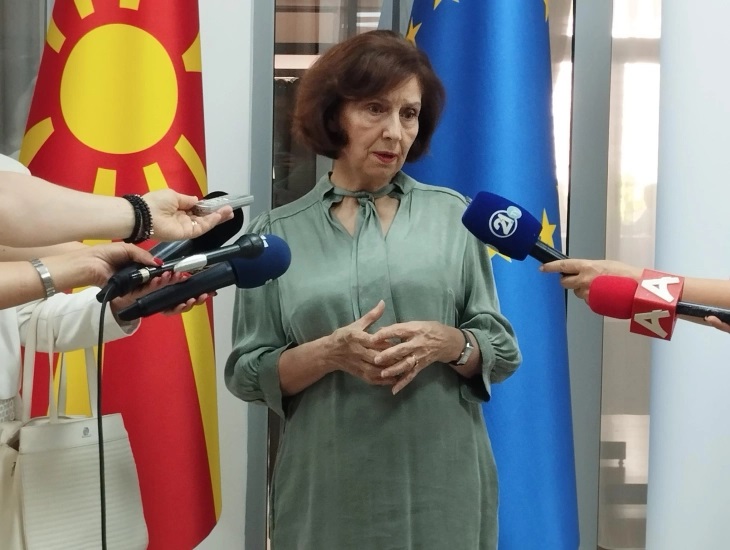
Skopje – In her annual speech to Parliament, President Gordana Siljanovska Davkova emphasized the need for a national consensus focused on ensuring that no new conditions arise in the European integration process.
“We must agree that there should be no double standards for EU membership. We have made significant constitutional changes at the EU’s request, including a name change that lacked consensus, yet we have not even started negotiations. We should agree that principles, once invoked, apply universally. The rulings of the European Court of Human Rights must be enforced,” President Siljanovska Davkova stated during her appearance on TV Kanal 5.
She stressed the importance of obtaining guarantees against any pressures to discuss identity issues, which she considers a core value of the EU.
“The national consensus must revolve around guarantees. We need assurances, and there are various ways to achieve this. Discussions have occurred; it’s not limited to a third protocol. It could involve amendments to the Protocol or the conclusions. Our situation is significant not just for us, but for all EU candidates,” said Siljanovska Davkova.
She noted that high-ranking European officials have affirmed the necessity for guarantees and the need to lift vetoes.
Siljanovska Davkova criticized the previous government’s agreements, arguing that they contradict the principles and values of the EU.
She pointed out that any EU member can trigger proceedings against Bulgaria for breaching fundamental principles and values. This can also be initiated by one-third of the MPs or the European Commission. Mechanisms exist to address these issues. Notably, assessments show that we are evaluated on the Green Agenda similarly to Moldova, yet we do not receive funding while they do.
“The EU must devise a strategy to sustain our progress, as we are discussing not just a more robust EU in a volatile multipolar environment. EU leaders have highlighted the need for resilience to potential influences and the importance of guarantees, considering ongoing security dilemmas, such as the refugee crises that may resurface. The EU has the capacity to find solutions if it wishes to, and we are urging them to do so. Why the reluctance? It appears practical and pragmatic agreements were reached. Had those proposing current resolutions acknowledged my points earlier, perhaps they would have influenced decision-makers more effectively. Instead, they have assured us that this was the only hurdle left before negotiations could begin,” Siljanovska Davkova concluded. (25 December 2025)







Leave a Reply