


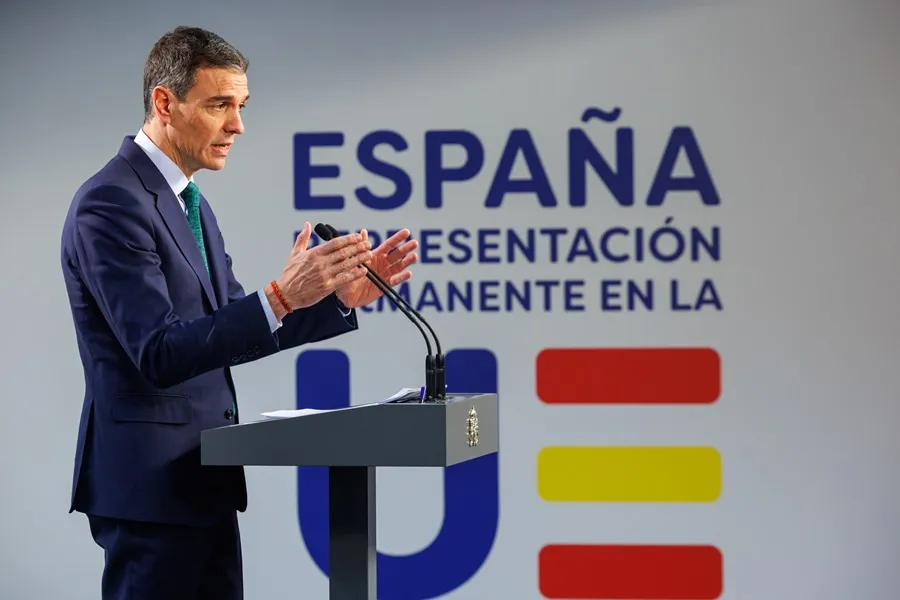
Madrid – A proposal to increase defense spending, which was endorsed by all EU member states yesterday and to which Pedro Sánchez has committed, has faced strong opposition from partners such as IU, calls for “common sense” from Sumar, and demands from the PP for more details and comprehensive support from the government.
Political parties have voiced their opinions on the agreement reached by EU leaders in Brussels to boost military spending in Europe, aiming for an investment of up to 800 billion euros. This comes at a time when the United States is re-evaluating its relationship with the EU and altering its strategy regarding Ukraine.
In Spain, the Prime Minister has proposed a commitment to increase defense spending to 2% of GDP by 2029, the original deadline set, though further specifics have yet to be provided. This plan will be discussed with various political leaders next week, with the exception of Vox.
The leader of the PP, Alberto Núñez Feijóo, has received an invitation from Moncloa for a meeting with the Prime Minister on Thursday to discuss Ukraine and defense expenditures. However, he has requested a written outline of the topics to be addressed ahead of the meeting.
“We are seeking a detailed, prior, and written report that sheds some light on the agenda,” Feijóo stated, emphasizing the need to understand what resources will be needed and what support exists for the proposal.
Among the government allies expressing their views on Sánchez’s proposal, the IU spokesperson in Congress, Enrique Santiago, voiced his strong opposition, calling it “ridiculous” for the EU to enrich American arms manufacturers, especially when the U.S. is perceived as a threat to its traditional allies like Europe and Canada. He called for an end to the war in Ukraine.
Santiago indicated that this viewpoint reflects a significant sentiment within Sumar, the coalition partner, though the Social Rights Minister, Pablo Bustinduy, has been less definitive. He emphasized that rearmament “does not appear to be the best approach” to enhancing European defense coordination and encouraged a “common sense” strategy regarding military spending increases.
Bustinduy cautioned against conflating the discussion with mere numerical targets for military spending, stating that the priority should be understanding existing capabilities and identifying areas for development in defense.
In addition to Feijóo, the PP’s congressional spokesperson, Miguel Tellado, has urged Sánchez to bring proposals that reflect the entire government’s input to these discussions, anticipating potential rifts within the coalition over this issue. Nonetheless, he acknowledged that the PP supports Spain fulfilling its international obligations.
He reminded that this commitment originates from the 2014 Wales summit and was reaffirmed by Pedro Sánchez at the NATO summit in Madrid in 2022, despite protests from some government factions.
Even the second vice president and leader of Sumar within the government had previously expressed concerns regarding the commitment to achieve 2% of GDP in military spending and called for an urgent meeting of the government pact monitoring committee.
Following Sánchez’s announcement to accelerate this commitment, Minister of Foreign Affairs, EU and Cooperation, José Manuel Albares, clarified that if the EU does approve an increase in military spending, it will serve as “a deterrent response” to Russia and is not considered “an act of aggression.”
“European nations reiterated their commitment to the unity and independence of Ukraine, defending it against an unjust and unjustifiable aggression that threatens us all,” added the Foreign Minister. (March 7)





Leave a Reply