


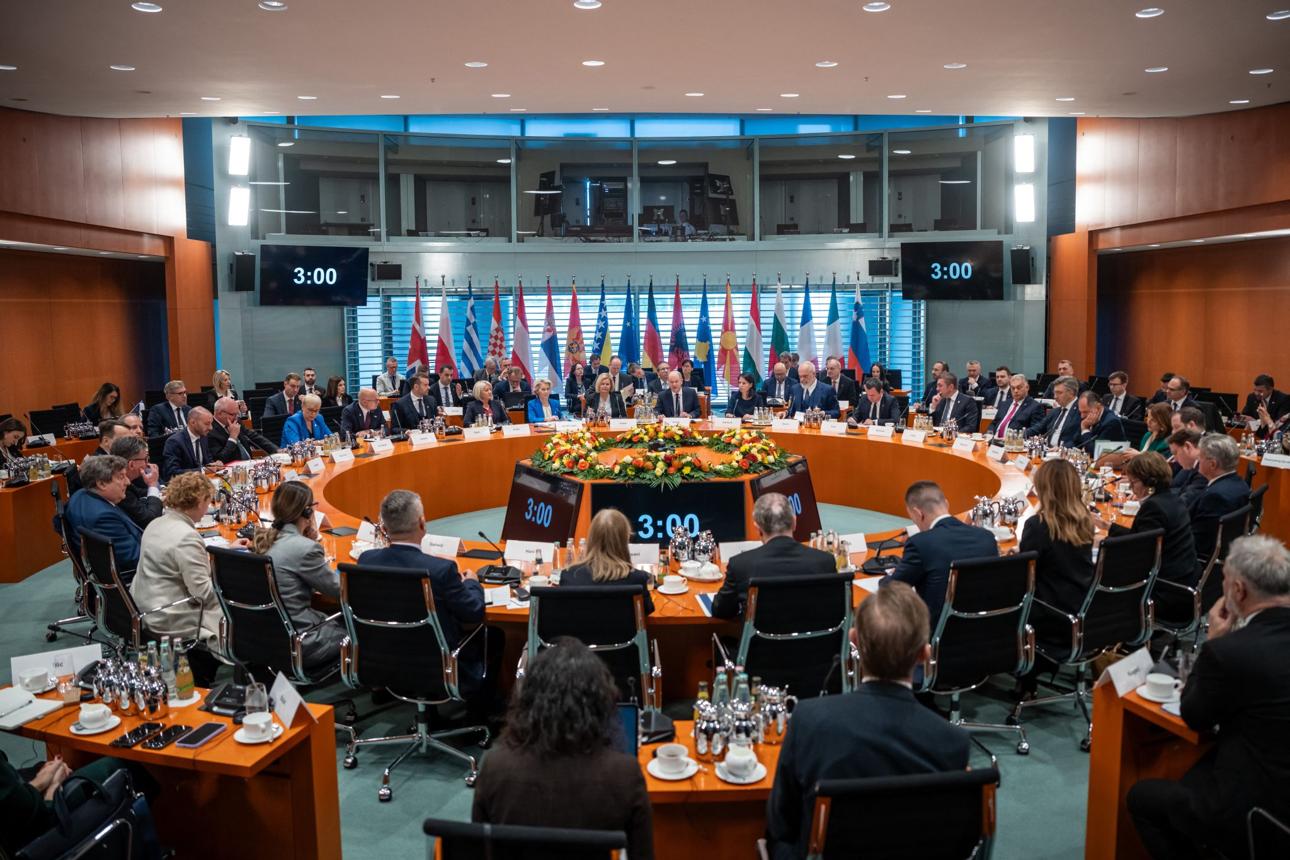
Western Balkan governments and Germany have committed to a work plan for those classed as “vulnerable” groups, such as Roma.
They formally named Roma as a target group for active labour market measures.
The Roma Foundation for Europe, whose close collaboration with the Montenegrin government secured the inclusion, welcomed the move and has now called on participating governments to “move from commitment to funded implementation.”
Monday’s Ministerial is the first time ministers of labour from the Western Balkans Six have gathered under the Berlin Process framework, a platform for high-level cooperation between the Western Balkan states and European partners to support the region’s EU integration path.
The Work Plan covers ten areas of cooperation and runs until May 2028.
Its adoption marks a shift in the Berlin Process from political declarations to sectoral commitments — with line ministries now taking direct ownership.
The Roma employment entry commits governments to exchanging good practices on employment programmes for vulnerable groups, with Roma as a national minority explicitly named alongside women, older workers and people with disabilities.
Commenting, Zeljko Jovanovic, president of the Roma Foundation for Europe, said, “The economic case is clear: closing the Roma employment gap in the Western Balkans would generate between €680 million and €2.08 billion in productivity gains per year across the six countries, with fiscal returns — taxes and reduced social assistance — of €139 million to €481 million annually.
“The region cannot afford to leave that on the table,” said Jovanovic.
Western Balkan economies, including Albania, a frontrunner to join the EU by 2030, face growing labour shortages and ageing workforces.
At the same time, 56 per cent of Roma aged 15–24 are not in education, employment or training.
Roma are already citizens, already speak local languages and are rooted in local communities.
Activating this workforce is not a question of charity — it is a condition for the region’s economic competitiveness and its EU integration path.
The Berlin Process Work Plan, for the first time, treats it as such.
Approximately 66,000 formal jobs need to be created across the Western Balkans to close the Roma employment gap — a figure governments acknowledged at the Tirana Ministerial last year. The Work Plan is the framework. Funded active labour market programmes are the next step.
The Ministerial falls less than a week before Roma Resistance Day on 16 May — the date Roma communities across Europe mark the armed uprising against deportation in Auschwitz-Birkenau in 1944. The timing is a reminder that Roma are not only a community shaped by historical persecution but an active force in Europe’s economic and political future.
Jovanovic added, “For the first time, ministers of labour in the Western Balkans have put Roma employment on the same table as skills, social dialogue and labour rights where they belong.
“This is not a symbolic gesture — it is a formal government commitment under a framework that feeds directly into EU accession. The region needs this workforce.
“Now governments must fund the programmes to reach it.”
The meeting’s outcomes reflects what the Work Plan already contains: Roma are named as a target group for active labour market measures. That is seen as a signal that political will is catching up with the economic evidence. The next step is funded implementation — beginning with programmes that go beyond temporary public works and reach Roma communities in sustainable employment.
Jovanovic: “Governments have made the technical commitment; the political conclusions should reflect it. We call on Berlin Process participants to close that gap.”
The Roma Foundation for Europe is a Brussels-based foundation working to “strengthen Roma agency and build a resilient Europe.”
Comments
20 responses to “Roma Advocates Celebrate "Renewed Commitment" to Inclusion”
-
Isn’t it adorable how governments are finally noticing the Roma community? 🤔 Next, they’ll probably declare that water is wet and taxes exist!
-
Looks like the ministers finally decided to toss the Roma a bone while patting themselves on the back for their “renewed commitment”—what a show! 🥳 Let’s just hope they remember that promises don’t pay the bills, eh?
-
Looks like the ministers finally decided to invite the Roma to the job market party—better late than never, eh? 🎉 Let’s just hope they don’t forget to actually bring the snacks this time! 🍽️
-
Looks like the Balkans have finally discovered that including Roma in the workforce isn’t just a nice idea but a money-making scheme—who knew! 💶 It’s about time they figured out that treating people as actual contributors might just boost the economy instead of just filling out paperwork. 🧐
-
Fantastic, nothing screams “we care” like a formal commitment to inclusion! 🤦♂️ If only these grand declarations came with a side of actual funding, we might just see some real progress instead of a well-rehearsed political theatre. 🍿
-
Seems like the Western Balkans have finally discovered that Roma workers might help with their labor shortages—who knew, right? 🤔 Next, they’ll be looking for a PhD in common sense!
-
Looks like the Western Balkans are finally taking a crack at not just talking the talk but maybe, just maybe, walking a bit too. Who knew asking for a fair shot at work could be the secret sauce to economic growth? 🤔💼
-
Who knew a “renewed commitment” could sound so much like a politician’s way of saying, “We’ll think about it, maybe”? 🤔 Just what the Balkans need—more meetings and plans while the Roma continue to wait for a proper job, right? 💼
-
Oh great, another “renewed commitment” that’ll probably gather more dust than my old office chair. But hey, at least it’s a step up from just talking about it over a pint, right? 🍻
-
Looks like the Western Balkans finally decided to include the Roma in their grand plans — about time, eh? 🥴 Maybe next they’ll get around to actually funding those fancy commitments instead of just talking about them over a pint! 🍻
-
Who knew a work plan could spark such a “renewed commitment”? Next, we’ll be celebrating the announcement of a commitment to commit to commitments! 😂
-
Oh, how lovely! It only took a ministerial meeting and a work plan for the Western Balkans to realize that Roma can actually contribute to the economy. But let’s hope the funding follows this “renewed commitment,” or we might as well hand out participation trophies. 😏💸
-
Looks like the Western Balkans just discovered that including Roma in the labor market might actually boost their economies—who knew? 🤔 Let’s just hope this “commitment” isn’t as hollow as a chocolate Easter egg! 🍫
-
Looks like we’ve finally found a way to turn “symbolic gestures” into “funded commitments” — now all we need is for governments to stop making empty promises faster than a Berlin Bratwurst vendor can sell out. 🍺🤑
-
Oh, how lovely! A “renewed commitment” to inclusion; I suppose we’ll finally see some action after all those years of “political declarations.” 🍷 Let’s just hope the paperwork doesn’t get lost in translation—again!
-
Looks like the Western Balkans are finally pulling their socks up and tossing a few crumbs to the Roma. Hope this “renewed commitment” comes with a side of actual funding and not just a warm handshake and a pat on the back! 😏
-
Oh, look, a grand “renewed commitment” to inclusion from the Western Balkans—just what we need, another shiny plan! 🤔 Let’s hope this one doesn’t end up gathering dust like the last 20.
-
Dedicating a whole plan to Roma inclusion? Quite the leap from just giving them a nod at the local pub! 🍻 Let’s see if they put their euros where their mouth is.
-
Lovely to see bureaucrats finally waking up to the fact that inclusivity might actually pay off! Who would’ve thought that acknowledging the Roma could lead to a slight uptick in productivity? 😏
-
Looks like the Western Balkans have finally decided to treat Roma like actual citizens instead of just a footnote in their economic plans. Who knew inclusion could be so fashionable? 🥴

Last News

Optimizing Business Profiles Enhances Google Reviews and Local Search Visibility
London, UK, June 25 – Eurotoday Newspaper — Business profile optimization is gaining renewed attention as businesses seek stronger positions in Google’s local search results. Digital marketing experts report that customer reviews remain one of the most influential signals supporting visibility in Google Search and Google Maps. Companies that actively manage their Google Business Profile and enco

EU Agreement Strengthens Safeguards Against Toxic Work Environments

Die Hitlergruß-Affäre der AfD

The Impact of Negative Online Reviews on Customer Trust and Solutions for UK Businesses
London, June 24 – Eurotoday Newspaper — Digital reputation services are becoming increasingly important as negative online reviews continue to affect customer trust across the UK. Consumers now rely heavily on online ratings and customer feedback when choosing products, services, and local businesses.
Why Businesses Are Investing in Reputation Management
Building Trust Through Positive Engagem

EU Agreement Digitizes Posted Worker Declarations
A voluntary single portal promises less red tape, but enforcement will decide whether mobile workers gain clearer protection
The European Union is advancing towards a single digital declaration system for posted workers, following a provisional agreement by Council and Parliament negotiators. This aims to simplify cross-border services and enhance labor protection oversight. The agreement could

EU seeks influencers to cover its summits — but only if they support the bloc
The guidance also states that content creators should not have any “significant or long-standing commercial collaborations” to prevent connections with big brands. The influencers will not recei

Media Coverage: A Powerful Reputation-Building Tool for UK Brands
London, June 24 – Eurotoday Newspaper — Corporate reputation management is becoming a key priority for UK businesses as companies seek to strengthen trust and credibility in a highly competitive digital environment. Despite the growth of social media marketing and online advertising, media coverage continues to play a vital role in shaping public perception and building brand authority.
Industry
Lithuania’s Government Resigns
The outgoing administration approved its resignation on June 23, as Ruginienė suggested returning the government’s powers to President Gitanas Nausėda. The Lithuania
European Leaders Commit to Strengthen NATO Role Ahead of Trump-Rutte Talks
NATO Secretary-General Mark Rutte, who is anticipated to meet Trump later on Wednesday, participated in the leaders’ discussions via video call. He is expected to deliver their message dir

US Defense Exports Advance with Turkey Jet Engine Sale Prior to NATO Summit
Washington, D.C., Ankara, June 24 – Eurotoday Newspaper — A planned agreement involving US defense exports is moving closer to approval as Washington and Ankara advance discussions on jet engine sales ahead of the upcoming NATO summit. Sources familiar with the matter say the move could strengthen defense cooperation between the two NATO allies at a critical time for regional security planning.
Leave a Reply