


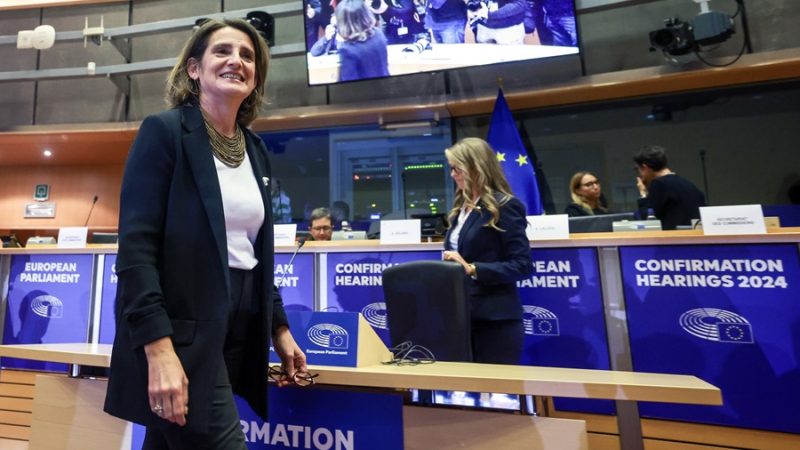
Brussels – The designated Vice President of the European Commission for a Clean, Fair and Competitive Transition, Teresa Ribera, defended her work in managing the storm during a heated parliamentary hearing marked by the prior maneuvers of the opposition PP to convince the European People’s Party (EPP) to reject the Spanish candidate.
The evaluation of Ribera, current third vice-president of the Spanish Government, and those of the other five candidates for vice-presidents of the new Commission will not take place until next week, after the EPP forced a delay in the meetings to assess the performance of the candidates, who occupy the highest positions in the organizational chart of the new community Executive.
Ribera’s hearing, one of the last on a marathon Tuesday in the European Parliament, was marked by questions from the PP and the far-right party Vox, who accused the third vice-president of the Spanish Government of the tragedy in Valencia and were joined by popular deputies from France, Germany, Finland, or Italy to ask about different aspects of crisis management.
“Alerts were issued in time. In fact, there were many institutions that following those alerts from previous days decided at seven-thirty in the morning on the 29th to cancel all activities, such as the University of Valencia or local authorities in many cities. That was not the case for other local institutions,” said Ribera in response to the PP spokeswoman, Dolors Montserrat.
“It was not the factual alerts or the prediction ones that failed, it was the alerts to the population and the measures to protect the population,” the Spaniard elaborated in response to an Italian popular deputy, while recalling that these are the responsibility of the Valencian Generalitat.
In addition to Montserrat, the Vox spokesperson, Jorge Buxadé, also accused her of having all the information in real-time and “doing nothing.” Other popular deputies highlighted the state of rule of law in Spain, the indictment in the Supreme Court of former Spanish Transport Minister José Luis Ábalos or the protection of farmers against wolves.
Climate change
Regarding the core of her portfolios, Ribera defended the controversial European law on nature restoration and also responded to several far-right German and Italian MEPs who are climate change deniers.
“The greatest concern for me, my children, or my grandchildren is denying the impact of climate change on our lives, on economic expectations,” she argued before pointing out that the latest data are “terrifying.”
And she argued: “In Europe we have the capabilities, tools, human resources and intellectual capacities to do many things and create prosperity and ensure the competitiveness of our industry.”
Competition
On Competition, she defended that it is “time to modernize and reinforce” that policy and she showed support for a “new approach” that gives more support to the growth of companies in the global markets, but which is “effective.”
“We must combine the internal market and competition approach. Working for champions that are much more capable in the international market at the expense of domestic competition is not a good solution,” Ribera warned.
The Spaniard also defended that the EU must strengthen its own tools to avoid the excessive concentration of power in the hands of large digital firms and was willing to update the guidelines on allowed state aid for housing, where the EU “can do much more than it has done until now.”
Spanish PP maneuvers
Ribera appeared this Tuesday before the MEPs already knowing that she will not know the evaluation of the European Parliament tonight, just like the rest of the designated executive vice-presidents, after the EPP forced in the morning to postpone the evaluation of the six candidates to next week.
Sources from the European People’s Party told EFE that Ribera “cannot pretend to come to Europe without first making things clear in Spain” and open the door for this week to allow negotiating changes in the package.
Sources from the PP, for their part, attribute the delay in the decision solely to their pressure on the EPP president, Manfred Weber, and consider it a victory to have managed to avoid Ribera being validated this very Tuesday or tomorrow Wednesday.
The change of date, they add, allows them to gain time to continue maneuvering against the Spanish candidate and try to convince the EPP as a whole not to support her, which would be a mortal blow to Ribera’s interests, because she needs the European populars to reach a simple majority.
It also allows the evaluation to not happen until after Ribera gives explanations in the Congress of Deputies about her actions in the storm crisis, something the Vice President of the Government requested this Monday and which the PP attributes to the fact that the Spanish populars stood firm with their European partners and this reached the ears of the social-democratic group.
“It has been a good occasion to exchange views on the challenges” of the EU, Ribera said at the end of her three-hour hearing, in which, she punctuated, “we have had some interventions a little less focused on Europe.” (November 12)








Leave a Reply