


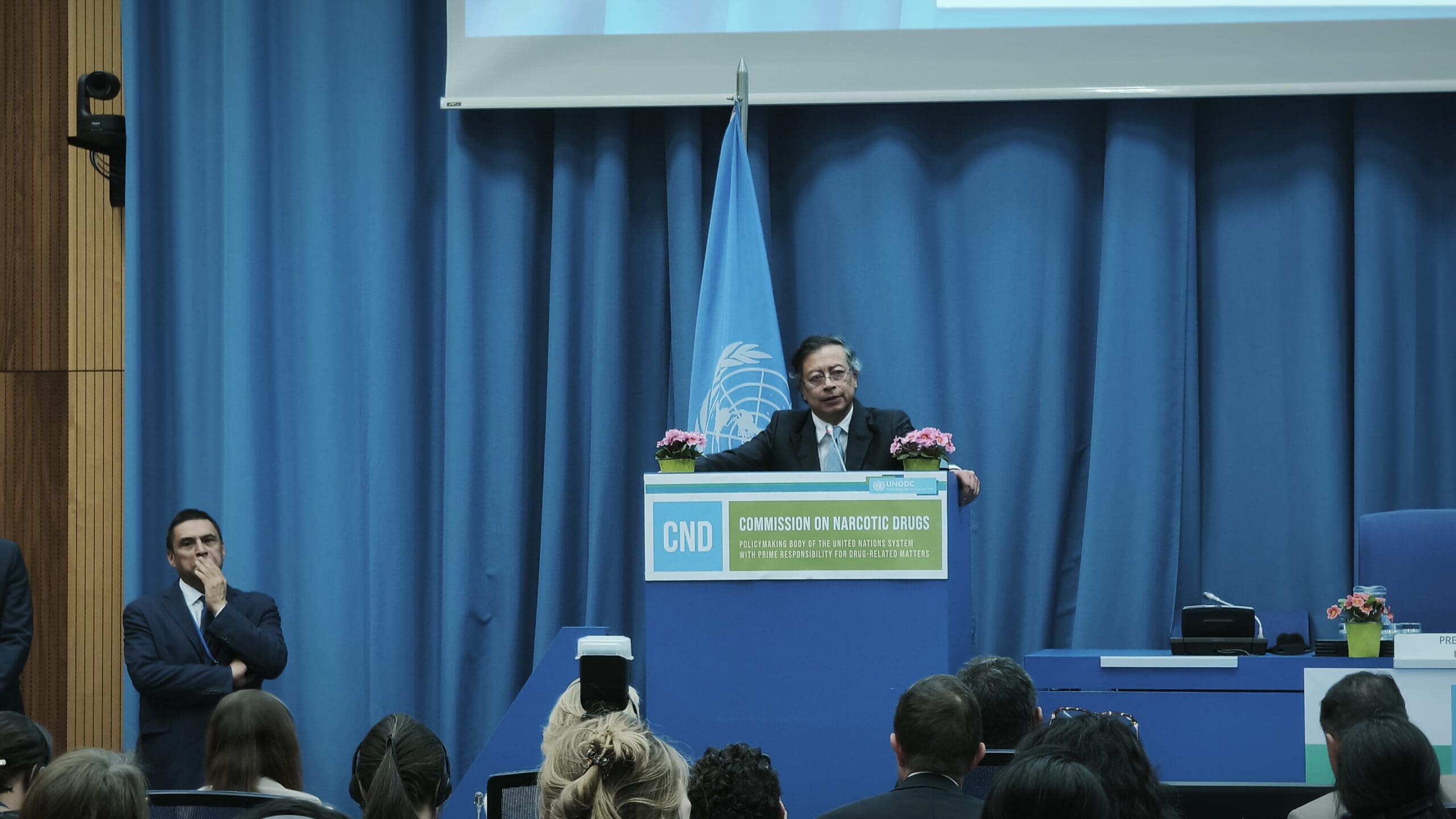
At the UN drug commission in Vienna on 9 March 2026, Colombian President Gustavo Petro delivered a speech that sharply criticised prohibition and highlighted the social causes of coca cultivation in Colombia. However, the main takeaway from his address, and from Europe’s own policy discussion, is not that total legalization is the answer. It is that drug policy must evolve beyond false dichotomies: states need improved prevention and education, serious investment in vulnerable communities, intelligence-led international cooperation, and ongoing action to dismantle the criminal and financial networks that benefit from addiction and violence.
During the opening day of the 69th session of the UN Commission on Narcotic Drugs in Vienna, Petro delivered one of the most politically charged speeches of the day. His address, published by the Colombian presidency, challenged decades of orthodoxy on the “war on drugs” while pushing delegates to confront a question that has troubled Latin America for years: what happens when prohibition punishes the poor, enriches organised crime, and still fails to curb demand?
Petro started with cannabis, using it as an example of what he sees as a historical and moral contradiction. Pointing to the contrast between the human cost of prohibition in producing countries and the legalization or normalization of cannabis in parts of the global north, he questioned why so many Colombians had died over a substance now legally sold in major American cities. His response was blunt: “Prohibition leads to the creation of the mafia. And the creation of the mafia leads to death and violence.”
That statement will be widely quoted, and rightly so. It encapsulates Petro’s critique. But it should not be oversimplified. His speech did not propose a complete legalization blueprint for every substance, nor did it advocate a permissive approach to drugs in general. Instead, it rejected the notion that criminal bans alone could solve a phenomenon driven by social despair, global demand, organized crime, and massive financial flows.
Beyond a Choice Between Prohibition and Legalization
That distinction is important. It is possible to accept Petro’s criticism of prohibition without concluding that total legalization is the obvious alternative. In fact, the stronger conclusion from Vienna is that neither formula, on its own, is enough.
Prohibition by itself has often fueled black markets, corruption, and violence, especially in fragile rural regions where poor farmers bear the costs and criminal organizations reap the profits. Yet legalization, by itself, would not automatically dismantle trafficking routes, criminal logistics, money laundering systems, or multinational distribution chains that now act more like transnational corporate crime structures. A legal market for one substance does not neutralize the networks trafficking others, nor does it solve addiction, predatory supply chains, synthetic drug threats, or the public health emergencies linked to abuse.
That is why the most credible interpretation of Petro’s intervention is not “legalize everything” but “stop pretending that repression alone works.” From there, the real policy question becomes more serious: how do states reduce demand, protect the vulnerable, and destroy the criminal infrastructure of supply?
Petro’s Social Diagnosis of the Drug Economy
One of the most striking parts of Petro’s speech was his effort to describe different drugs not only chemically, but sociologically. Cannabis, he argued, emerged in modern history as a substance associated with youth protest. Cocaine, by contrast, belonged to a different social order. “Cocaine is the drug of capital, no longer of protest,” he said. “It is necessary to increase the working day.” In another pointed phrase, he described it as “the drug of Wall Street.”
Whether one fully agrees with that framing or not, the political purpose was clear. Petro was trying to shift attention from Colombia’s fields to the societies that consume, finance, and normalize the demand. In that sense, his speech was also a challenge to Europe. As the
Can’t believe we’re still having this convo in Vienna, it’s like discussing how to improve the Titanic’s lifeboats after it hit the iceberg. 🙄 Maybe just a thought, but a little less prohibition and a bit more common sense might just be the ticket, eh? Just what we needed—more philosophical musings on drug policy from a president while the real issues get swept under the rug like last year’s Christmas leftovers. Who knew that “prohibition creates crime” was such an epiphany? 🤷♂️ Seems like Petro’s taking the scenic route to enlightenment at the UNODC—who knew drug policy talks could double as a sociology lecture? 🤔 Maybe next time he’ll throw in a PowerPoint on the benefits of toasting marshmallows over prohibition fires too. 🍫🔥 Seems like President Petro is ready to trade his coffee for a degree in sociology—who knew a speech at the UN could double as a lecture on drug economics? 🤔 Maybe next time, he could open a café for the confused delegates. 🍵 Petro’s got the knack for turning a UN speech into a TED Talk, hasn’t he? 🤔 Who knew a politician could make drug policy sound so… avant-garde? Maybe next time he can sell tickets for the show. 🎟️ Quite the show in Vienna, isn’t it? A Colombian president schooling the world on drug policy while we sip our espresso and pretend we know what we’re doing… 😂 What a revelation from Petro! Who knew that prohibition might not be a brilliant strategy? Next, he’ll suggest we stop using umbrellas when it rains too! ☔️😏 Talk about shooting fish in a barrel! 🤦♂️ Here we are, solving the world’s drug problems with a PowerPoint presentation in Vienna – next week we’ll have a seminar on how to stop climate change with a nice cup of tea. Cheers to progress! 🍵💼 What a revolutionary idea – perhaps next he’ll suggest we just throw all our problems into a big pot and call it ‘soup for thought.’ 🍲 #BrilliantSolution Looks like Petro thinks he can solve the drug problem with a speech, as if the UN is just waiting for a Colombian president to drop some wisdom bombs. 🍷 Who knew fighting crime was just a matter of changing the narrative? At the UN drug commission in Vienna on 9 March 2026, Colombian President Gustavo Petro delivered a speech that sharply criticised prohibition and highlighted the social causes of coca cultivation in Colombia. However, the main takeaway from his address, and from Europe’s own policy discussion, is not that total legalization is the answer. It is that drug policy must evolve beyond false dichotomi Vienna has become a diplomatic hub as the 69th session of the United Nations Commission on Narcotic Drugs begins at UNODC headquarters, gathering governments, researchers, and civil-society organizations for a week of discussions on prevention, synthetic drugs, treatment, and future global drug policy directions. Hungary’s data protection authority is meant to protect citizens from abuse. However, European courts and institutions have raised questions about its independence when secrecy, surveillance, and political power intersect: is the watchdog truly independent, or just independent on paper?
Comments
9 responses to “Petro Advocates for Smarter Drug Strategy at UNODC Vienna”
Last News
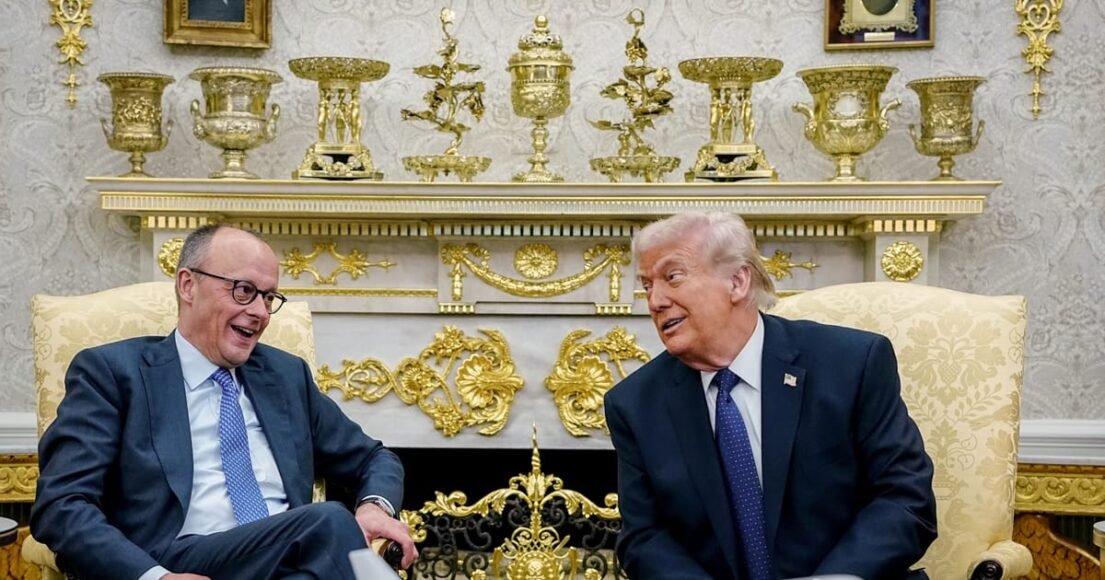
Spanish Deputy Leader Criticizes Merz for His Deference to Trump
Afterward, the chancellor explained he didn’t defend Spain openly to avoid escalating the
Petro Advocates for Smarter Drug Strategy at UNODC Vienna

Hungary Proposes Legalizing Seizure of Ukrainian Cash Convoy
Hungarian authorities say they are examining whether the convoy — stopped while transiting the country last week — posed national security risks. They are also investigating the origin and intended use of the money.
Hunga
Meg Nocero Honored as IAOTP’s Top Happiness Officer of the Year
NEW YORK, NY, UNITED STATES, March 5, 2026 /EINPresswire.com/ — The International Association of Top Professionals (IAOTP) has named Meg Nocero as the Top Happiness Officer of the Year for 2026, recognizing her exceptional leadership and commitment to her field. Nocero, an award-winning author, happiness expert, and host of the “M
Macron Urges Escort for Container Ships and Tankers in Strait of Hormuz Immediately
Macron’s visit to Cyprus on Monday followed drone attacks on the island after U.S.-Israeli strikes on Iran that led to regional conflicts.
“When Cyprus is attacked, it is Europe that is attacked,” M
Vienna Hosts Global Drug Policy Debate at UN CND 69
VIENNA — The 69th session of the Commission on Narcotic Drugs has placed Vienna at 
Crise énergétique : le G7 envisage de recourir aux réserves stratégiques de pétrole

Hungary’s Data Watchdog Faces a Credibility Crisis
Hungary’s National Authority for Data Protection and Freedom of Information (NAIH) serves as a key democratic 
What to Do If You’re Unfairly Fired in the EU
Across the European Union, labor laws aim to protect employees from arbitrary or discriminatory dismissal. While exact procedures vary by country, EU
Wie Özdemirs Sieg den Kanzler in die Krise stürzt
In zwei kurzen Interviews dazu: Uni

Leave a Reply