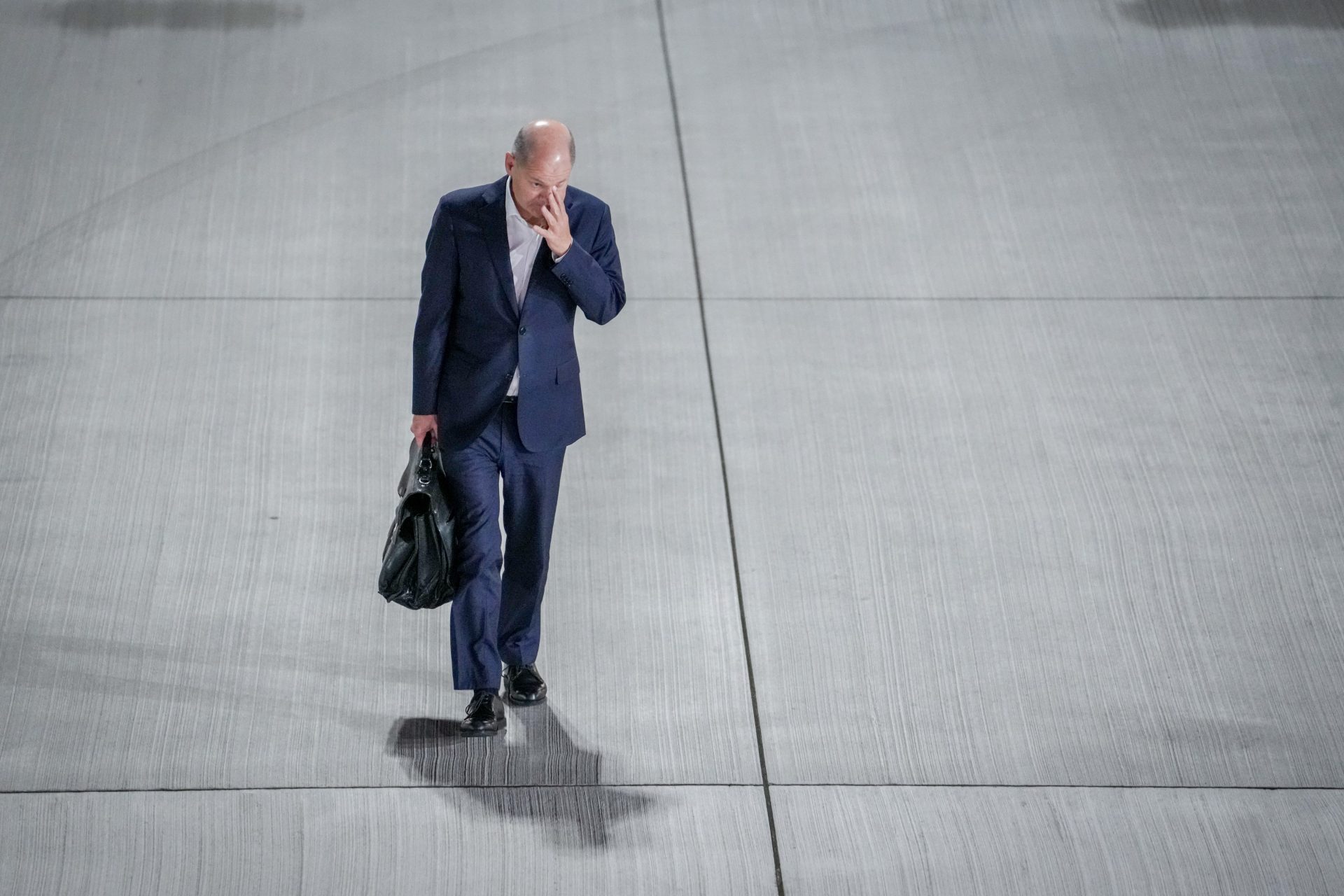
Opposition leader to Chancellor: Immediate vote of confidence, otherwise nothing will happen

Berlin – The German governing coalition of the SPD, Greens, and FDP has failed, and a new election is pending in Germany – only when? According to the opposition, the German economy, and European partners, a new Bundestag should be elected as quickly as possible and ideally still in January. However, Chancellor Olaf Scholz (SPD) has other timing ideas: He wants to pose the vote of confidence in the Bundestag on January 15 and thus bring about an early election at the end of March. Federal President Frank-Walter Steinmeier has a key role in this process and says: “I am ready for this decision.”

EU leaders for quick election in Germany

Finnish Prime Minister Petteri Orpo hopes for a quick new election in Germany. Europe needs a strong German government, Orpo said on the sidelines of a summit of the European Political Community (EPG) in the Hungarian capital, Budapest. Belgian Prime Minister Alexander De Croo, his Swedish counterpart Ulf Kristersson, and Danish Prime Minister Mette Frederiksen agreed.

Scholz originally also wanted to attend the EPG summit. Due to the domestic political situation, he wanted to travel there only in the evening. The summit of the heads of state and government of the EU countries will then follow. Countries like Ukraine, Great Britain, and Turkey are also part of the European Political Community.

Opposition: Merz’s talk with Scholz on cooperation ends without results

It is known that the relationship between Chancellor Scholz and opposition leader Friedrich Merz (CDU), the union’s candidate for chancellor, is tense. Nevertheless, Scholz offered cooperation to the CDU/CSU immediately after Finance Minister Christian Lindner’s (FDP) expulsion from the government.

A roughly hour-long conversation between Merz and Scholz, according to information from the Union faction, ended without results. Merz made it clear that the Union was ready to talk about agenda items or laws in the Bundestag. But first, the chancellor must pose the vote of confidence by the beginning of next week at the latest. Merz then considers a possible election date in the second half of January.

Scholz: Do what is necessary for the country

But Scholz sticks to his schedule. He will do what is necessary for the country, said the SPD politician. “Citizens will soon have the opportunity to decide anew how things should proceed.” Cooperation with the Union is about finding solutions to strengthen the economy and defense – on issues “that are crucial for our country, to work constructively together: in the rapid strengthening of our economy and our defense.”

Presumably difficult government formation after new election

In the event of a new election, forming a government in Germany is unlikely to be easy. While the Union could expect to become the strongest force for now, it is unclear who would be a possible coalition partner. In polls conducted before the coalition breakup, the Union parties have recently been clearly ahead with values over 30 percent.

The SPD, Greens, and FDP are significantly weaker compared to the 2021 federal election. The SPD stood at around 15 percent and behind the AfD with about 18 percent, the Greens around ten percent. The FDP was worried about re-entering the Bundestag. CSU leader Markus Söder has repeatedly categorically excluded black-green (a coalition of CDU/CSU and the Greens). (November 7)

Comments

Leave a Reply

Your email address will not be published. Required fields are marked *

Last News

L’UE inflige une amende de 200 millions d’euros à Temu

L’UE inflige une amende de 200 millions d’euros à Temu

L’application de vérification de l’âge est vue comme un élément crucial des efforts de l’UE pour protéger les enfants des dangers en ligne et des risques pour la santé mentale.

Read More

US Keeps Kyiv Embassy Open as Ukraine’s Security Situation Remains Tense

US Keeps Kyiv Embassy Open as Ukraine’s Security Situation Remains Tense

Eurotoday is a daily online newspaper based in Belgium. BM publishes unique and independent coverage on international and European affairs. With a Europe-wide perspective, BM covers policies and politics of the EU, significant Member State developments, and looks at the international agenda with a European perspective.

Read More

Europe’s Far Right Faces Ban Threat

Europe’s Far Right Faces Ban Threat

Europe’s far right is facing scrutiny as a European Parliament watchdog aims to ban the Alternative for Germany’s EU party.
On the show, Zoya Sheftalovich and Sarah Wheaton examine how the far-right Europe of Sovereign Nations party — associated with Germany’s AfD — is at risk of losing EU funding and its political party status. A 300-page letter from the Authority for European Political Par

Read More

European Citizen Rights Guide

European Citizen Rights Guide

A delayed flight, a refused residency document, or a suddenly blocked bank account after moving to a new country often pushes individuals to seek guidance on European citizen rights only when problems arise. This is when the gap between formal rights and practical access becomes evident. European citizenship provides actual protections, but these are not automatic and are not always smoothly impl

Read More

Blair’s Speech Sparks New Debate on Labour’s Identity, With or Without Starmer

Blair’s Speech Sparks New Debate on Labour’s Identity, With or Without Starmer

Blair and Starmer have had distant relations in recent months, as noted by a senior figure at the Tony Blair Institute for Global Change. Blair, having relinquished significant influence over the Starmer operation, now aims to transcend the traditional right or left dichotomy, focusing on broader centrist ideas essential for Britain’s advancement. He envisions politics that are more aspirati

Read More

Norway Aligns with France’s Nuclear Deterrence Policy

Norway Aligns with France’s Nuclear Deterrence Policy

“Russia’s largest nuclear arsenal is located in the High North, near Norway,” he stated, emphasizing Norway’s continued reliance on NATO for security.
On March 2, the French president announced that Germany, Poland, Greece, the Netherlands, Belgium, Denmark, and Sweden agreed to discuss nuclear cooperation with Paris. This may include joint nuclear drills, information shari

Read More

Debate on European Nuclear Deterrence Intensifies Following Norway’s Support for France’s Security Role in Oslo 2026

Debate on European Nuclear Deterrence Intensifies Following Norway’s Support for France’s Security Role in Oslo 2026

OSLO, Norway – May 27 – Eurotoday Newspaper — European nuclear deterrence discussions are gaining momentum after Norwegian Prime Minister Jonas Gahr Støre indicated that Norway would come under France’s nuclear umbrella, marking a potentially significant development in Europe’s evolving security structure.
The statement comes during a period of heightened geopolitical uncertainty, increasing Arcti

Read More

Von der Leyen to Meet Hungarian PM Magyar on Friday

Von der Leyen to Meet Hungarian PM Magyar on Friday

Budapest aims to mend its strained relationship with Brussels following long-standing conflicts under former leader Viktor Orbán.
Magyar, whose centrist party recently won Hungary’s election, is working to access billions in EU funds frozen due to violations of EU laws under Orbán’s 16-year governance.
Securing €10.4 billion in EU post-pandemic recovery funds is the top priority for th

Read More

Kazakhstan’s Energy Crisis Worsens as Rosatom Approaches Balkhash Nuclear Agreement for Astana 2026

Kazakhstan’s Energy Crisis Worsens as Rosatom Approaches Balkhash Nuclear Agreement for Astana 2026

ASTANA, Kazakhstan – May 27 – Eurotoday Newspaper — Kazakhstan energy crisis concerns are intensifying as Russian nuclear giant Rosatom moves closer to participating in the country’s planned Balkhash nuclear power project, a development that could reshape Central Asia’s long-term energy landscape.
Kazakhstan’s government has increasingly warned about electricity shortages, rising industrial deman

Read More

Power Rivalries and Their Impact on the Middle East and Horn of Africa

Power Rivalries and Their Impact on the Middle East and Horn of Africa

In a period marked by intricate challenges, the United Arab Emirates (UAE) has become a true stabilizing force in the region, achieving this not through rhetoric, but with tangible actions and measurable impacts. The UAE’s strategy has consistently aimed to avert state collapse and manage disorder. This dedication has driven the UAE to adapt, forge robust security alliances, and invest in i

Read More