


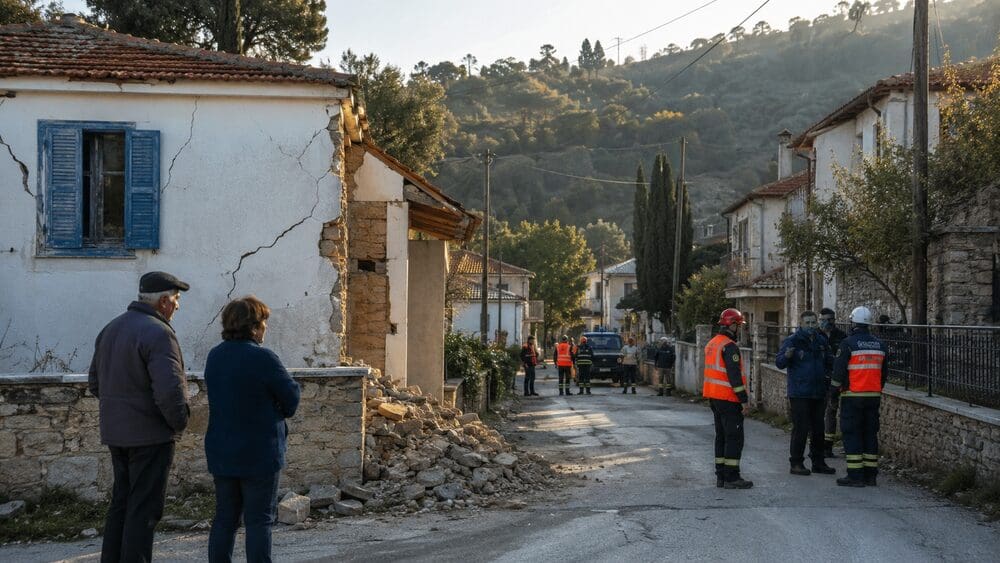
Inspections Underway in Central Greece After Recent Earthquake Sequence
Central Greece is currently undergoing assessments of its homes, roads, and public structures following a series of earthquakes in northern Evia. Schools in the affected zones remained closed on Monday as a safety measure. No injuries have been reported; however, the tremors experienced as far as Athens have highlighted the importance of safety measures in this seismically active European region.
The largest tremor, rated at 5.2 magnitude, occurred near Prokopi on Sunday, following earlier shocks of 4.8 and 4.3. According to Greece’s Institute of Geodynamics, the seismic activity is classified as preliminary, with automatic locations subject to review by seismologists.
Residents of Prokopi, Dafnousa, and nearby areas are primarily concerned about the safety of their homes, roads, and schools rather than just the magnitude of the earthquake. Shallow tremors can be widely felt and may cause significant disruption without mass casualties, leaving cracks, landslides, and uncertainty.
Impact on Roads and Schools
On Monday, local reports indicated that landslides affected sections of the road network, impacting homes, businesses, public buildings, and at least one church. Fire service teams were deployed to clear road debris after rockfalls.
The school closures for inspections reflect a standard cautious approach following seismic events. Children, the elderly, and those in structurally weak homes are most at risk in the aftermath, as aftershocks and blocked roads aggravate the situation.
Authorities in Greece are still determining the full impact, while seismologists have not yet confirmed if the 5.2-magnitude quake was the main event. Public confidence in such regions depends on prompt, clear communication and guidance.
Broader Implications for European Preparedness
Greece faces significant seismic risks, but the lessons extend beyond its borders. Earthquakes challenge local government capacity, building standards, and emergency response systems.
The European Union has supported earthquake responses, as noted in previous instances such as the EU Civil Protection Mechanism. While Evia’s situation is not as severe, it underscores the importance of prevention, assessment, and public trust.
Current priorities in northern Evia focus on thorough assessment rather than declarations. Despite no injuries, damaged infrastructure carries social costs. Restoring access and providing reliable updates are essential.
The next few days will reveal if precautions need amplification. Regardless, the situation highlights the role of local resilience: inspected facilities, accessible roads, safe homes, and effective communication preempting fear.








Leave a Reply