


Title: Military Strikes Continue in Myanmar Amid Earthquake Relief Efforts: UN Raises Alarm
As Myanmar reels from a devastating earthquake, UN officials have strongly condemned ongoing military attacks that are hindering recovery and humanitarian operations.
“At a time when all efforts should be focused on getting life-saving aid to the disaster zones, military forces are instead conducting attacks,” said UN Human Rights Office spokesperson Ravina Shamdasani, speaking to journalists in Geneva.
Since the earthquake struck on 28 March, there have reportedly been more than 120 military assaults, with over half occurring after a ceasefire was meant to commence on 2 April.
Strikes in Populated Quake-Affected Zones
According to Shamdasani, most attacks have involved aerial bombing and artillery shelling, including in earthquake-hit regions. “Numerous strikes have taken place in densely populated areas, raising serious concerns of indiscriminate attacks and violations of international humanitarian law, particularly the principle of proportionality,” she said.
Even before the natural disaster, Myanmar was grappling with political, economic, and humanitarian crises. The military, which seized control in February 2021 from the democratically elected government, has been engaged in ongoing conflict with opposition groups.
Barriers to Aid and Call for Amnesty
UN High Commissioner for Human Rights, Volker Türk, has urged Myanmar’s military to immediately cease hostilities and remove any obstacles preventing the delivery of humanitarian aid.
Many of the worst-affected areas, particularly in the Sagaing region—controlled by anti-military groups—have been relying heavily on local volunteers for rescue efforts and to meet basic needs.
“With Thingyan, Myanmar’s traditional New Year, approaching, we call for unity and compassion to support those most affected,” Shamdasani added.
The UN Human Rights Office (OHCHR) has also called for a general amnesty for those imprisoned since the 2021 coup, including prominent political figures such as State Counsellor Aung San Suu Kyi and President U Win Myint.
Health Risks and UNICEF Warnings
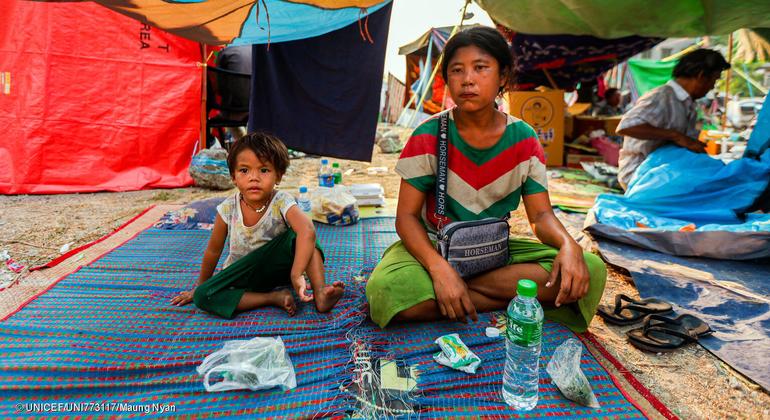
The ongoing crisis, exacerbated by the earthquake, has created what UNICEF describes as a “perfect storm” for disease outbreaks.
UNICEF Myanmar’s chief of health, Eric Ribaira, warned that even before the quake, the country was dealing with preventable disease outbreaks like measles, dengue, cholera, and malaria. “The risk is now significantly higher, especially for children living in displaced and overcrowded conditions with limited access to clean water and sanitation,” he told UN News.
He highlighted the dangers of respiratory infections caused by debris and dust, and the urgent need to maintain maternal and child health services. UNICEF has already reached 700 pregnant and nursing women with clean delivery kits and is looking to help many more.
General medical kits have also been deployed to serve up to 250,000 people over the next three months. However, Ribaira emphasized the need for continued and expanded support. “We must act now to prevent further illness and ensure safe childbirth and accessible health care,” he urged.
UN Coordinates Emergency Relief
In response to the growing humanitarian needs, the UN and its partners have launched a $275 million funding appeal, expanding the existing humanitarian response plan to target 1.1 million people impacted by the earthquake.
An estimated two million people have been newly pushed into humanitarian dependency due to the disaster, adding to the nearly 20 million already in need of assistance.
Aid organizations and donor countries have quickly mobilized to provide essential services, including emergency health care, shelter, clean water, hygiene products, and food.
To boost response efforts, the UN’s Central Emergency Response Fund (CERF) has disbursed an additional $5 million, doubling its earlier allocation for Myanmar’s earthquake relief.
As the humanitarian crisis deepens in Myanmar, global leaders and aid organizations continue to urge an immediate halt to hostilities, full access for relief operations, and renewed efforts to protect civilians and restore dignity to those impacted.








Leave a Reply