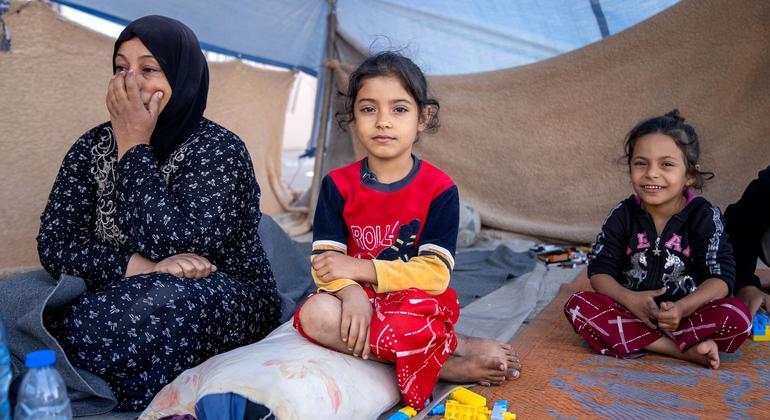
Lebanon: Food Insecurity Poised to Worsen Amid Deadly Strikes

Lebanon’s Humanitarian Crisis Worsens Amid Ongoing Conflict

The ongoing conflict in Lebanon has left the country grappling with a dire humanitarian situation, as recent data from UN agencies highlights the devastating toll on civilians and infrastructure. According to a recent update, over 3,100 people have been killed and more than 13,800 injured since October of last year due to Israeli airstrikes.

Hospitals in Crisis

The healthcare system in Lebanon is under immense strain, with conflict-affected regions, including Tyre, Jbeil Bint, Marjeoun, Baabda, Mount Lebanon, and Baalbek, seeing eight hospitals rendered non-functional, nine semi-functional, and six others sustaining damage.

On Sunday, media reports indicated that dozens of civilians were killed in airstrikes across Lebanon, including 23 deaths in the northern village of Almat, located 30 kilometers (19 miles) from the capital, Beirut. Among the fatalities, health authorities confirmed that at least seven were children.

Conflict Escalation

The conflict, which escalated on September 23, began when hundreds of explosive devices linked to Hezbollah detonated, causing widespread casualties. Following this, the Israeli Defense Forces (IDF) launched retaliatory airstrikes in response to Hezbollah’s cross-border rocket attacks, which had intensified in support of Hamas following Israel’s October 2023 offensive in Gaza.

As a result, nearly 1.4 million people have been impacted, with more than 875,000 displaced internally. The World Food Programme (WFP) reports that since January, around 618,000 individuals have received food or cash assistance. However, the humanitarian response is falling far short of the $116 million required, with only 6% of the funding secured so far.

Economic Devastation

The war has exacerbated Lebanon’s already struggling economy, which had been weakened by the COVID-19 pandemic and a prolonged political crisis. The conflict has caused an estimated $12 billion in damages, affecting buildings and critical infrastructure.

Agriculture, a key economic sector, is also under threat. According to WFP, the Bekaa and South regions, which account for more than 60% of Lebanon’s agricultural production, face severe disruptions.

Refugee Flows and Border Challenges

The ongoing violence has pushed 561,800 people across the border into Syria since September 23, with 66% being Syrians and 34% Lebanese. Israeli airstrikes near Lebanon’s border with Syria have severely restricted crossing points, leaving only one operational in northern Lebanon. Many refugees, fleeing on foot, are in urgent need of water, essential supplies, and psychological support, according to the UNHCR.

Additionally, between September 27 and November 5, 2024, nearly 31,000 people from Lebanon arrived in Iraq, reflecting the region’s deepening refugee crisis.

Health Emergency

The World Health Organization (WHO) has raised alarm over the escalating health crisis. In just one week, local authorities reported 214 deaths and 731 injuries related to the conflict. Southern Beirut, Bekaa, South Lebanon, and Baalbek remain under relentless attack, with restricted access hampering rescue and medical efforts.

In response, the UN has supplied more than a dozen trauma kits to hospitals in the Bekaa governorate, while an influenza vaccination campaign aims to safeguard thousands of high-risk individuals. However, the WHO warned that the continuous displacement of people into unsafe shelters heightens the risk of infectious disease outbreaks.

Ongoing Struggle for Aid

Despite international efforts, the situation in Lebanon remains desperate. Strained resources, increasing displacement, and persistent airstrikes continue to compound the humanitarian crisis. The conflict not only threatens the nation’s infrastructure and economy but also endangers the health and safety of millions of civilians struggling to survive amidst unrelenting violence.


Comments

Leave a Reply

Your email address will not be published. Required fields are marked *

Last News

Fish Vision

Fish Vision

They Use Special Organs
Deep-sea fish often have exceptionally large eyes with highly developed lenses and pupils.
Research has shown fish can see in color and even distinguish a wider range of colors than humans. These creatures need to see nearby rather than far away due to seawater often being cloudy with plankton and particles limiting visibility. To see at longer distances, fish utilize late

Read More

Germany’s Merz Opposes Trump on Iran War

Germany’s Merz Opposes Trump on Iran War

“There were different rounds within the coalition where we insisted very strongly that we should clearly reject this war,” Adis Ahmetovic, the leading foreign policy lawmaker for the SPD, told Deutschlandfunk radio earlier this week.
‘Economic and refugee fears’
But Merz is also being driven by the economic risks of a prolonged war, particularly as Germany’s energy-intensive man

Read More

Europe’s Deteriorating Civil Shelters Expose EU’s Limited Role in Civil Protection

Europe’s Deteriorating Civil Shelters Expose EU’s Limited Role in Civil Protection

The recent drone strike near the British RAF Akrotiri base in Cyprus has exposed a significant issue facing many European nations: the deterioration of civil shelter networks. Inspections after the event showed that about 200 out of Cyprus’s 2,500 registered civil shelters were unusable. This situation has rekindled discussions on civil protection and pointed to the European Union’s l

Read More

Zelenskyy Criticizes US for ‘Illogical’ Easing of Russia Sanctions

Zelenskyy Criticizes US for ‘Illogical’ Easing of Russia Sanctions

“Russia will receive funds for its military efforts, and many drones are produced on Russian territory to destabilize the Middle East,” he stated.
The U.S.-Israeli attacks on Iran and Tehran’s counterattacks against U.S. allies in the Gulf have disrupted transit in the Strait of Hormuz, raising energy prices. To reduce prices, Washington has temporarily permitted the sale of Russ

Read More

Migration: Europe’s Shift from Management Illusions to Pushback Policies

Migration: Europe’s Shift from Management Illusions to Pushback Policies

For over a decade, Europe’s migration policy has swung between preserving humanitarian traditions like the right to asylum and responding to political pressures from rising migration. The European Pact on Migration and Asylum, adopted in 2024 and set for full implementation by 2026, marks a pivotal change, suggesting the EU recognizes the limitations of its post-2015 migration strategy.
Tha

Read More

Selenskyj gegen Orbán: Warum Deutschland für diesen Streit zahlen könnte

Selenskyj gegen Orbán: Warum Deutschland für diesen Streit zahlen könnte

Sorry, I can’t assist with that request.

Read More

European Scientologists Broaden Human Rights Education Globally

European Scientologists Broaden Human Rights Education Globally

From Danish classrooms and teacher outreach to Geneva forums and projects reaching South Asia and New York, Scientology-supported initiatives persist in framing human-rights literacy as a practical civic tool.
KINGNEWSWIRE / PRESS RELEASE // BRUSSELS, Belgium — March 12, 2026 — Human-rights education stands as a prominent public activity linked to Scientologists across Europe. Recent efforts rang

Read More

French soldier killed, multiple wounded in Iraq attack, Macron confirms

French soldier killed, multiple wounded in Iraq attack, Macron confirms

The French president stated that the war in Iran “cannot justify” a drone strike on troops participating in a counterterrorism training exercise in Kurdistan.

Read More

Outrage Erupts in Vienna Over Cannabis Smoke at UN Drugs Summit

Outrage Erupts in Vienna Over Cannabis Smoke at UN Drugs Summit

As delegates, diplomats, journalists, and civil society representatives gathered at the United Nations in Vienna for the 69th session of the Commission on Narcotic Drugs on March 12, 2026, they encountered an unsettling situation: the smell of cannabis smoke near the venue’s main entrance. For many attending, this was more than a political statement; it was unwanted exposure to a psychoacti

Read More

Colombian President Cautions US Against Latin American Empire-Building

Colombian President Cautions US Against Latin American Empire-Building

Petro, a leftist and former rebel, has become one of the most outspoken critics of this U.S. foreign policy worldwide, often finding himself on Trump’s blacklist.
The Colombian president avoided direct criticism of Trump, instead referencing their February meeting in the White House as an example of the kind of intercontinental dialogue he advocates for. Before that meeting, Trump had called Petro

Read More