



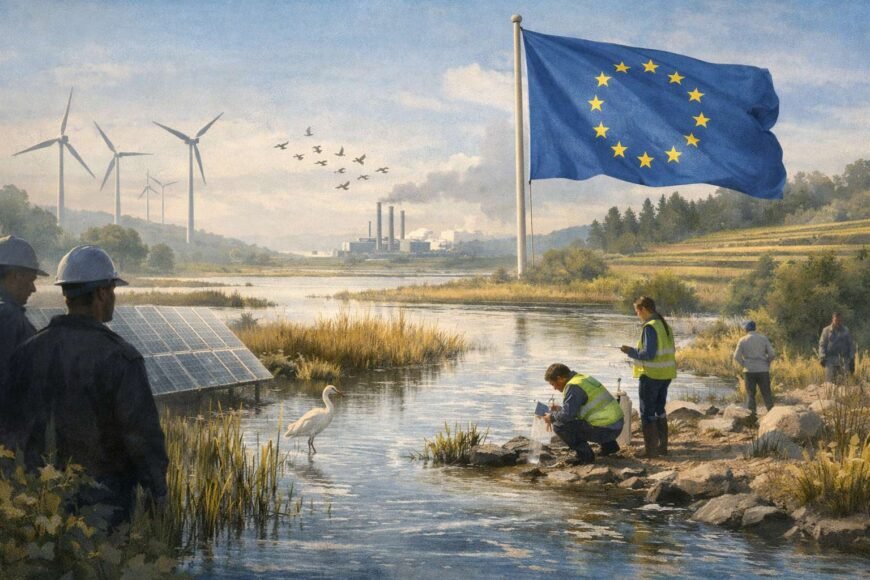
The European Commission has approved over €103 million for seven strategic projects within the LIFE programme, supporting initiatives in Finland, France, Greece, the Netherlands, Portugal, Slovakia, and Spain. This package is presented as a blend of environmental policy and an investment in economic resilience, public health, and Europe’s competitive edge.
The funding, announced through the European Commission’s press service, covers approximately 36% of a €284 million envelope for long-term projects focusing on climate adaptation, water resilience, marine restoration, circular economy reforms, and sustainable land use.
This framing is politically significant. The EU is under pressure to balance climate goals with industrial competitiveness and public concerns over transition costs. The Commission presents green spending as strategic investment, with Climate Commissioner Wopke Hoekstra emphasizing its necessity for the economy, security, and independence, and Environment Commissioner Jessika Roswall highlighting Europe’s natural infrastructure as a foundation for resilience and competitiveness.
A programme with a broader political role
The LIFE programme is the EU’s sole funding instrument dedicated to environment, climate, and clean-energy objectives, with over 6,500 projects supported since 1992. The latest package aligns with broader policy goals: supporting the European Climate Law, EU Biodiversity Strategy for 2030, Water Framework Directive, and marine and mobility objectives.
Practically, Brussels aims to show that climate policy can mean flood protection, cleaner water, stronger coastal economies, reduced material use in industry, and better preparedness for extreme weather. The Commission emphasizes that these projects should mobilize additional national and private investment vs. functioning as isolated EU grants.
The move comes as LIFE-style actions are signaled to remain part of future EU budget cycles, including proposals linked to competitiveness and decarbonization. These are not just environmental grants but a preview of Brussels’ future political defense of green spending.
Seven countries, seven priorities
These projects span various geographies, each addressing a specific vulnerability or transition:
-
Finland: ACWA LIFE receives €16.5 million for restoring and protecting streams, lakes, coastal waters, river basins, and groundwater.
-
France: LIFE ADAPT EST gets €15.6 million to enhance climate resilience in the Grand Est region, including water governance and infrastructure adaptation.
-
Greece: LIFE SIP GR Blue receives €8.9 million for marine ecosystem restoration and combating pollution, litter, and underwater noise.
-
Netherlands: CEL4LIFE is backed with €6.9 million to help Limburg cut raw material use in chemicals, manufacturing, and construction by half by 2030.
-
Portugal: LIFE IP AGRILOOP will receive €15.8 million to promote circular solutions in the Azores across agroforestry, agrifood, and tourism.
-
Slovakia: NatAdaptSK gets €10.1 million for nature-based solutions covering water, forests, agriculture, and biodiversity.
-
Spain: LIFE HumedalES receives €29.7 million, the largest ever financed under LIFE, aiming to restore 26,200 hectares of wetlands across 107 Natura 2000 sites, key for flood control, biodiversity protection, carbon storage, and water security in Europe.
Why the package matters
This announcement is a routine funding story, yet signifies how the EU is adjusting Green Deal-era language, focusing beyond emissions and targets to speak about droughts, floods, island economies, and industrial raw materials.
This broader language reflects political realities: climate policy must now show visible benefits in regions facing extreme weather, strained ecosystems, and economic uncertainty. Projects like these demonstrate Brussels’ attempt: through local interventions, not just grand declarations.
The challenge remains in delivery. Such strategic projects, operating over many years and authorities, are transformative yet institutionally demanding, relying on EU funds and national, regional, and private follow-through.
The Commission’s announcement reflects Europe’s current mood: the green transition advances but is defended with pragmatism—resilience, security, competitiveness, and quality of life. For Brussels, this €103 million package’s political message is crucial.
This decision also builds on earlier LIFE-backed actions, like the €86 million for climate resilience and water quality projects covered by The European Times.




Leave a Reply