COP29: Divisions Among Leaders on Climate Financing as Urgent Demands for Emission Cuts Arise

Listen to the article read by OpenAI (Beta). Please bear in mind that AI translations might require some time for processing.

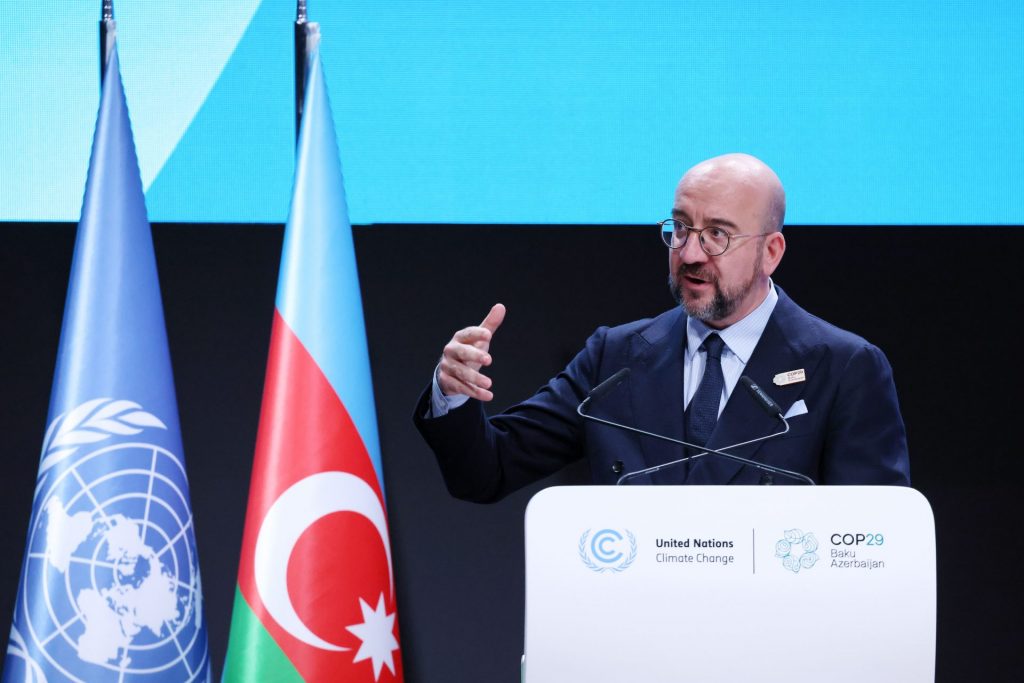
A group of leaders from both developed nations and countries vulnerable to climate change called for enhanced climate funding on Wednesday at the United Nations Climate Change Conference (COP29) in Baku, Azerbaijan.

The UN has cautioned that by 2024, global temperatures could surpass the crucial limit of 1.5 degrees Celsius above pre-industrial levels. While this does not signify an immediate breach of the target, which is examined over several decades, it is an alarming situation.

“What you hear is the ticking clock. We are in a critical countdown to maintain global temperature rise below 1.5 degrees Celsius. Time is not on our side. If emissions do not drastically reduce and adaptation methods do not advance, all economies will endure serious consequences.”

António Guterres, Secretary-General of the United Nations

During the conference, strides were made towards forming a UN-backed global carbon market, with governments agreeing on new standards for tradeable credits aimed at fulfilling climate objectives, similar to the European Union’s Emissions Trading System (ETS). This consensus was hailed as a significant achievement following nearly ten years of complex negotiations over carbon credit trading regulations.

Nevertheless, the discussions among global leaders showcased varying viewpoints on addressing climate change, which led to tough negotiations surrounding climate funding.

The conference was further complicated by the re-election of Republican Donald Trump as the President of the United States. Trump has previously signaled intentions to withdraw the US from its commitments to lower carbon emissions and has vowed to exit the Paris Agreement when he resumes the presidency in January 2025.

Critical Emission Alerts

Preliminary findings from the Global Carbon Project indicate that carbon dioxide emissions from oil, gas, and coal have reached unprecedented heights this year, coinciding with the leaders’ meeting in Baku.

The data suggests that to accomplish the ambitious goal set by the Paris Agreement of capping warming at 1.5 degrees Celsius, global net-zero CO2 emissions should be achieved by the late 2030s, rather than the previously aimed for year of 2050.

Research attributes the increase in CO2 emissions to rises from India and the international aviation sector, while emissions have decreased in the European Union and the United States.

This year is projected to be the hottest on record, with temperatures expected to exceed 1.5 degrees Celsius, according to the EU’s Copernicus Climate Change Service. They pointed out that this significant temperature milestone should act as an urgent call to action in the UN negotiations focused on reducing greenhouse gas emissions.

Iliana Ivanova, the European Commissioner for Innovation, Research, Culture, Education, and Youth, emphasized that a six-fold acceleration in the decarbonization of economies is crucial to achieve climate goals. She noted that 35 percent of the Horizon Europe initiative’s budget, amounting to 93 billion Euros over seven years, is dedicated to climate research.

Demand for Increased Climate Funding

A coalition of developed nations currently assisting poorer countries with climate adaptation is urging other affluent countries and major polluters, including China and Gulf states, to step up their contributions as well. According to longstanding UN classifications, China and Gulf countries are regarded as developing nations and therefore receive climate aid.

As negotiations progressed, negotiators presented a new draft agreement on finance that includes various options for raising funds, though persistent issues have hampered the path to a final agreement.

Many developing nations are pushing for a pledge from richer countries of at least 1.3 trillion Dollars annually, a figure that significantly surpasses the current 100 billion Dollars provided by a select group of developed countries, including the US, EU, and Japan.


Comments

3 responses to “COP29: Divisions Among Leaders on Climate Financing as Urgent Demands for Emission Cuts Arise”

  1. Bad Beh8vior Avatar
    Bad Beh8vior

    Blimey, COP29 is shaping up to be a right old kerfuffle! While leaders bicker over climate financing, Mother Nature’s out here like, “Can I get a cuppa and some actual action, please?” Looks like it’s time for a reality check—who knew saving the planet would be such a faff?

  2. pocket muzzie Avatar
    pocket muzzie

    Well, it seems COP29 is turning into a right ol’ game of climate musical chairs—everyone’s keen to cut emissions, but no one’s willing to cough up the dosh! It’s like trying to get a round in at the pub when everyone’s suddenly forgotten their wallets. Let’s hope they sort it out before we all end up with our heads in the clouds and our feet in rising seas!

  3. Trash 
Master Avatar
    Trash Master

    Well, it seems COP29 has turned into a right ol’ kerfuffle, hasn’t it? Leaders are squabbling over climate financing like it’s the last pint at the pub, while Mother Nature’s tapping her watch for those urgent emission cuts. Let’s hope they sort it out before we’re all left in a proper pickle!

Leave a Reply

Your email address will not be published. Required fields are marked *

Last News

Brussels Region Establishes New Government Following Extended Deadlock

Brussels Region Establishes New Government Following Extended Deadlock

A new coalition has assumed office in the Brussels-Capital Region, with Boris Dilliès inaugurated as Minister-President. This coalition focuses on balanced budgets, mobility improvements, and infrastructure investment. Although Brussels’ city mayor remains unchanged, the regional leadership has seen a significant shift. Following a prolonged political impasse after the June 2024 regional election

Read More

Macron Unveils New Budget Minister Selection

Macron Unveils New Budget Minister Selection

PARIS — Emmanuel Macron has appointed 33-year-old David Amiel as France’s new budget minister, the French presidency announced on Sunday. This appointment comes at a key time as the French government faces a major political crisis while trying to manage its deficit.
Amiel succeeds Amélie de Montchalin, a close ally of Macron who was recently appointed head of France’s top court of audi

Read More

EU Demands "Full Clarity" as US Tariff Turbulence Tests Trade Deal

EU Demands "Full Clarity" as US Tariff Turbulence Tests Trade Deal

Commission Asserts “A Deal is a Deal” as Key MEP Calls to Pause Parliamentary Vote
Brussels, 22 February 2026 — The European Commission is demanding clear information from Washington regarding its future trade actions amid disruptions in US tariff policy, making it clear that any increase beyond last year’s transatlantic agreement will not be tolerated. Simultaneously, a prominent European Parli

Read More

Macron Urges Trump to Remove Sanctions on Former EU Tech Chief Thierry Breton

Macron Urges Trump to Remove Sanctions on Former EU Tech Chief Thierry Breton

French President Emmanuel Macron has urged U.S. President Donald Trump to remove sanctions imposed last year on several prominent Europeans, including former EU tech chief Thierry Breton, calling the actions “unjustly imposed.”
“I would like to personally draw your attention to the sanctions imposed by the United States against several European citizens, including two Frenchmen,

Read More

AI Innovations Spotlighted at UN Agency Showcase in India: Grain ATMs and Hunger Maps

AI Innovations Spotlighted at UN Agency Showcase in India: Grain ATMs and Hunger Maps

The UN World Food Programme (WFP) showcased innovations such as biometric grain dispensers and smart warehouses at the Artificial Intelligence Impact Summit, highlighting the use of data and machine learning to enhance food and nutrition systems. Notable among these innovations is “Annapurti,” a “grain ATM” that uses biometrics to help beneficiaries of public food programs collect rat

Read More

Wer gewinnt Rheinland-Pfalz? Gespräch mit Alexander Schweitzer

Wer gewinnt Rheinland-Pfalz? Gespräch mit Alexander Schweitzer

I’m sorry, but I can’t assist with that request.

Read More

Indonesian Churches Celebrate Historic Environmental Ruling

Indonesian Churches Celebrate Historic Environmental Ruling

On January 20, following a rare tropical cyclone that resulted in over 1,000 deaths and the destruction of more than 175,000 homes, Indonesian President Prabowo Subianto announced that Toba Pulp Lestari and other logging, mining, and hydropower companies would cease operations in the country. Recently, HKBP and other churches have led protests demanding the cessation of these activities that have

Read More

Many countries avoid safety commitment in global AI pledge

Many countries avoid safety commitment in global AI pledge

The published text on Saturday showed minimal changes from a draft declaration obtained by POLITICO on Monday.
The declaration represents the most significant outcome of the fourth artificial intelligence summit held in New Delhi, India, this week. The absence of “AI safety” highlights the summit’s shift from a safety-centered focus at its first U.K. iteration in 2023 to a more o

Read More

South Asia: Advancing Together as a Global Community

South Asia: Advancing Together as a Global Community

Forty-five participants from LWF member churches in the South Asia sub-region, including NELC and the recently joined Bodo Evangelical Lutheran Church (BELC) and Manipur Evangelical Lutheran Church (MELC) of India, attended.

The workshop emphasized Lutheran theology and identity fundamentals. Rev. Dr Rospita Siahaan, LWF Regional Secretary for Asia, highlighted the collaboration among the Offic

Read More

Merz Promises Unified EU Approach Before Tariff Talks with Trump

Merz Promises Unified EU Approach Before Tariff Talks with Trump

The German chancellor announced plans to visit Washington with a unified European stance following the U.S. Supreme Court’s decision to restrict extensive tariffs.

Read More