


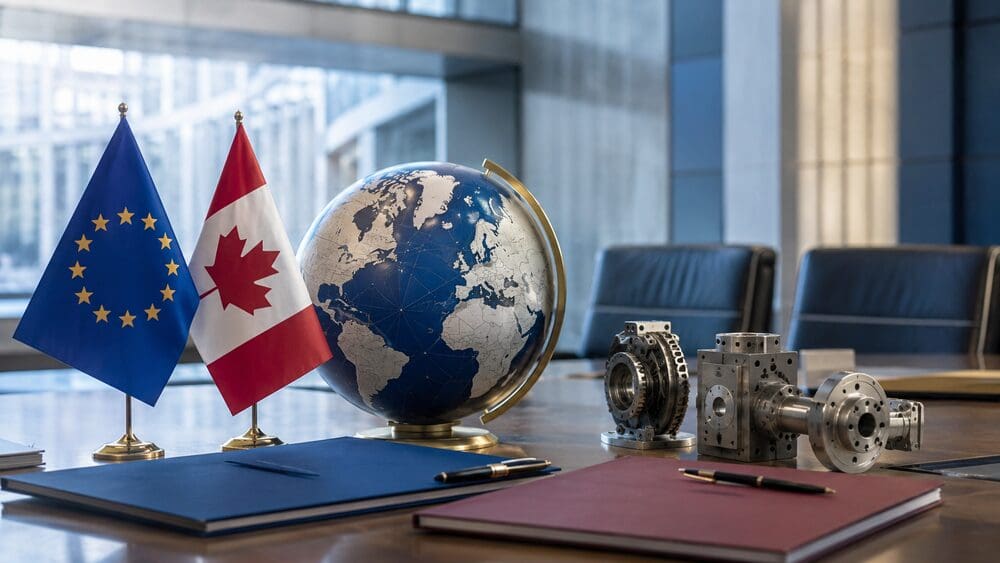
The Council’s decision makes Ottawa the first non-European participant in SAFE, expanding Europe’s joint procurement network as defense readiness advances from pledges to contracts.
The Council of the European Union has finalized an agreement permitting Canadian companies and products to participate in procurement under the EU’s Security Action for Europe instrument, or SAFE. Announced on 15 June, this move involves a close NATO ally in Europe’s new common defense procurement framework, marking the first inclusion of a non-European country in the scheme.
The decision grants Canada access to a program designed to aid EU member states in financing joint defense purchases and rapidly expanding industrial production. It also indicates that the EU’s defense-readiness agenda is becoming more outward-focused, while attempting to maintain strategic autonomy and address capability gaps revealed by Russia’s war against Ukraine.
A first outside Europe
According to the Council decision, Canada is the first non-European country to join SAFE. The agreement, signed on 14 February 2026, is linked to the EU-Canada Security and Defence Partnership established at the Canada-EU summit in June 2025.
SAFE, adopted in May 2025 as part of the EU’s Readiness 2030 defense package, aims to support member states investing in defense industrial production through common procurement, focusing on priority capabilities and quicker equipment access.
The instrument not only serves as a financing mechanism but also seeks to organize demand across European governments, enabling defense manufacturers to plan production more reliably. This is crucial in areas where Europe has faced shortages, slow delivery cycles, and fragmented national purchasing.
What Canada gains, and what Europe wants
The Canadian government describes SAFE as a €150 billion loan program managed by the European Commission to support and expedite defense procurement by EU member states. Under terms released by Ottawa, Canadian firms will receive preferential access and treatment in SAFE-financed procurement opportunities.
The agreement allows Canadian content to constitute up to 80% of a procurement’s total value under SAFE, significantly higher than the 35% threshold for other third countries. Canada will also make an initial financial contribution of €10 million, partly as a down payment against future participation fees.
For Brussels, the attraction is both practical and political. Canada offers an advanced defense industrial base, NATO interoperability, and a strategic relationship that is increasingly significant as Europe seeks dependable partners beyond its immediate vicinity. The Council also states that Ukraine, EFTA and EEA countries, candidate countries, and countries with EU security and defense partnerships can participate in common procurement under SAFE.
Strategic autonomy, with partners
The agreement underscores a central tension in Europe’s defense debate: the EU wants stronger European industrial capacity but also requires trusted partners for swift procurement. Canada’s participation indicates Brussels’ effort to balance this by opening selected procurement channels while maintaining rules on eligibility, content, and contributions.
This approach may prevent SAFE from becoming an insular fund at a time when European security is connected to the broader North Atlantic. However, it also raises questions relevant as contracts are awarded: how much value will remain in Europe, how supply chains will be protected, and how transparent future procurement decisions will be.
The broader political message is evident. Defense cooperation now extends beyond communiqués and summit rhetoric. It is increasingly being constructed through purchasing regulations, industrial capacity, and financing instruments. As European defense cooperation becomes more operational, the EU faces the challenge of demonstrating that speed, accountability, and democratic oversight can progress together.
Canada’s entry into SAFE is more than a market-access decision. It is an early indicator of how Europe might build a defense economy around trusted partnerships while striving to retain public control over security priorities. The initial contracts will reveal whether that promise translates into capacity, or merely adds another layer to institutional architecture.









Leave a Reply