


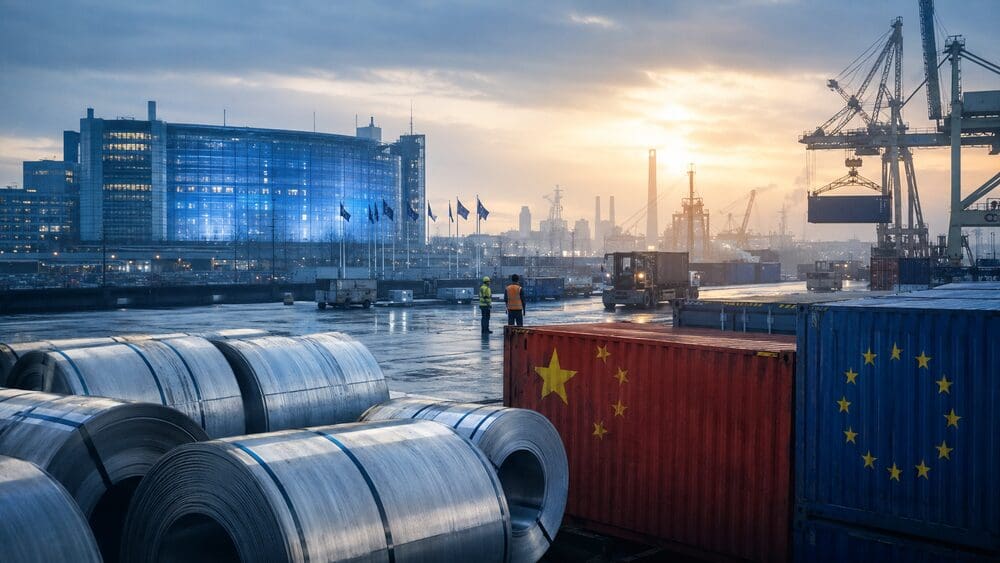
European leaders are under growing pressure to adopt a tougher trade stance toward China, as concerns about industrial overcapacity, a growing goods deficit, and vulnerable manufacturing sectors become more prominent on the EU agenda ahead of the June European Council meeting.
The discussion intensified when Manfred Weber, chair of the center-right European People’s Party, called for more decisive action against the risk of Chinese competition undermining European industry. His warning about EU-China trade tensions reflects a shift in Brussels, where China is increasingly seen not only as a major export market but also as a challenge to Europe’s industrial resilience.
Data from Eurostat’s 2025 trade figures gives weight to the political argument. The EU exported €199.6 billion worth of goods to China and imported €559.4 billion, resulting in a goods trade deficit of €359.8 billion. Exports fell by 6.5% from 2024, while imports increased by 6.4%.
This disparity has become a political symbol of Europe’s vulnerability in key sectors related to jobs, climate policy, and strategic autonomy, such as machinery, chemicals, steel, batteries, and vehicles. For trade hawks, these figures highlight the EU’s traditional preference for gradual dialogue has not kept up with China’s rapid, state-backed industrial expansion.
However, more cautious governments and companies worry that a tougher stance could lead to higher consumer prices, provoke retaliation, and complicate access to a market that remains important for European exporters. Germany’s industrial base, in particular, has long relied on Chinese demand, even as German manufacturers face stronger Chinese competition domestically and abroad.
The EU’s challenge is to protect core industries without resorting to a generalized trade war. Brussels has already increased its use of trade-defense tools, including investigations and tariffs, while emphasizing that its China policy is focused on “de-risking” rather than fully severing economic ties.
Steel has been an early battleground. The EU has adopted tougher steel trade defense measures in response to global overcapacity and pressure on European producers. Similar concerns are spreading to other industrial sectors, where policymakers fear that low-cost imports could weaken domestic capacity before new green and digital investments fully develop.
The human impact is significant. Factory closures and disrupted supply chains affect workers, regional economies, and public finances. At the same time, poorly designed protection could impose higher costs on households and smaller firms. The challenge for EU institutions is not only to protect large producers but to demonstrate that trade policy can benefit the broader public interest.
The issue is likely to be a topic of discussion before the European Council on 18 June, where leaders will be urged to define the extent of their actions. France and several other member states have advocated for stronger measures, while others are cautious about actions that might fragment the single market or expose exporters to retaliation.
In EU terms, China is still described as a partner, competitor, and systemic rival. This captures the relationship’s complexity but no longer resolves the policy disagreement. Europe seeks access to Chinese markets, cooperation on climate issues, and stability in global trade, alongside fair competition, supply-chain security, and protection from subsidized overcapacity.
The coming weeks will reveal if the EU can create a coherent industrial strategy balancing these elements. If not, pressure could shift from Brussels to national capitals, where governments facing factory closures and public dissatisfaction may act independently. For Europe, the trade issue is evolving into a broader question: can the single market safeguard its productive base while staying open, lawful, and socially responsible?





Leave a Reply