


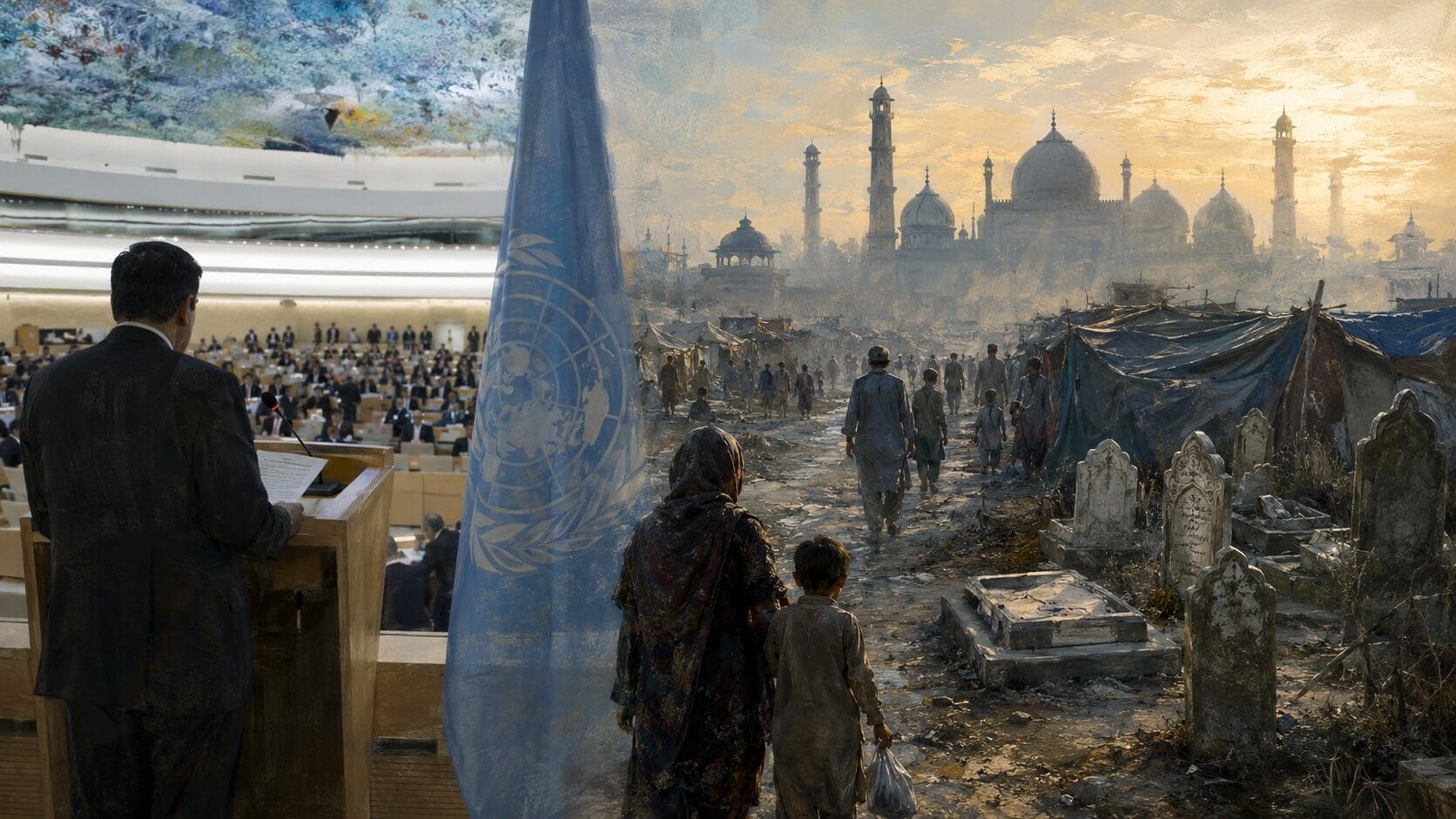
On March 6, Muneeb Ahmed of the Pakistani Delegation stated at the United Nations Human Rights Council that “Pakistan ensures comprehensive protection for religious rights of minorities.”
The statement is blatantly false. Ahmed and the diplomats present at Geneva’s Palais d’Nations knew this. The Pakistani Delegation was aware that everyone recognized their deceit. This reflects the deep level of hypocrisy and cynicism in Pakistan, shared by many Human Rights Council members, most being autocratic regimes violating human rights to maintain power.
Ahmed’s statement responded to a report by UN Special Rapporteur Nazila Ghanea on religious freedom related to death and honoring the deceased. The report highlights that in Pakistan, Ahmadis are deemed “non-Muslim” by the Constitution (Second Amendment) Act, 1974, and are criminalized by Ordinance No. XX of 1984 for identifying as Muslim. This legal framework legitimizes discrimination, even in death and burial. Authorities often deny Ahmadis access to graveyards, desecrate graves, and support mobs obstructing funerals.
The report further notes that local government acts give graveyard control to union councils; however, implementation is discriminatory towards Hindus and Sikhs, with Ahmadi graveyards being encroached upon and burials often denied. Ahmadis are criminalized for Islamic inscriptions on graves.
The report is well-sourced, referencing court cases and independent reports. Ahmed questioned these sources’ authenticity, as revealing them could endanger informants.
Religious persecution in Pakistan is documented by respected human rights organizations and government agencies. Human Rights Watch reports increased attacks on religious minorities and places of worship, with persecution of Ahmadis embedded in law and encouraged by the government.
The International Federation for Human Rights (FIDH) notes growing violence and discrimination against minority communities in Pakistan. The United States Commission on International Religious Freedom observes the government’s unwillingness to address mob violence. Amnesty International highlights that mob attacks are manifestations of the threat of vigilante violence, disproportionately affecting religious minorities.
Thousands of Pakistani Christians, Ahmadi Muslims, and others have fled to Thailand, Malaysia, and elsewhere, escaping discrimination, violence, and murder. They endure squalid refugee camps, hoping for resettlement in countries respecting religious freedom. Pakistani policies have devastated their lives and burdened the United Nations High Commission for Refugees.
The Pakistani regime shows no sympathy for these victims. Its statement to the Human Rights Council, veiled in diplomatic language, exposes bigotry unfit for a civilized nation. For Pakistan, the Council serves as a propaganda tool for political aims, akin to totalitarian states.
Aaron Rhodes was Executive Director of the International Helsinki Federation for Human Rights (1993-2007) and President of the Forum for Religious Freedom-Europe (2014-2025). He authored The Debasement of Human Rights (Encounter Book, 2018) and Human Rights Without Illusions (Academica Books, 2025).










Leave a Reply