


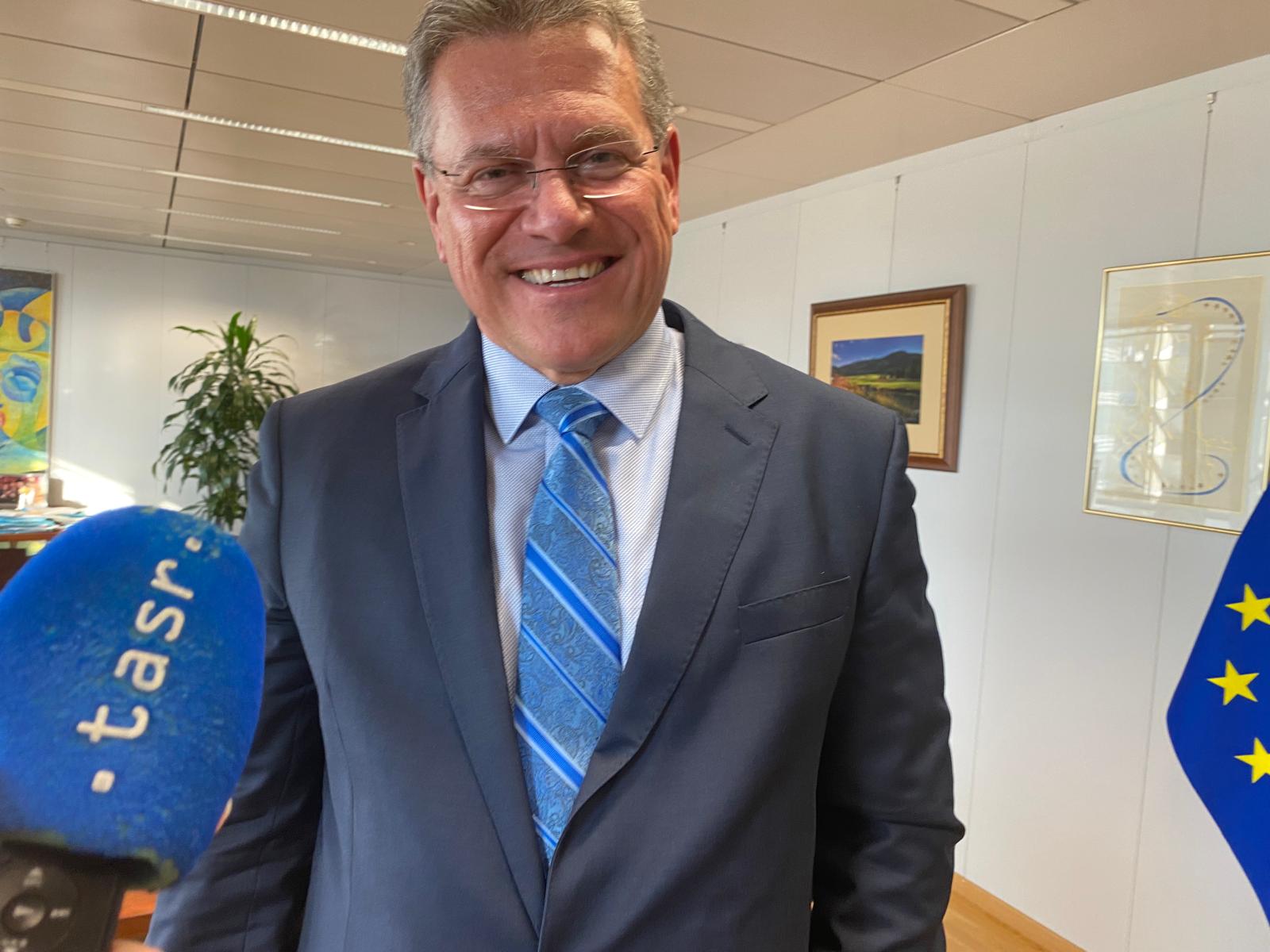
Brussels – European Commissioner for Trade and Economic Security, Maroš Šefčovič, described managing the EU’s trade policy in 2025 as his greatest professional challenge during a meeting with Slovak journalists in Brussels, as reported by TASR.
Maroš Šefčovič emphasized that the trade landscape has “completely changed” over the past year. The EU has faced three main challenges: stabilizing relations with the USA, responding to China’s assertive policies, and capitalizing on the heightened global interest in trade agreements with Europe.
“Both we and our partners are navigating similar circumstances. They value Europe as a reliable partner that establishes mutually beneficial agreements,” he noted.
Šefčovič indicated that the perspective of the European Commission (EC) and the EU on economic security has “dramatically” shifted, recognizing the need for more mutually advantageous free trade agreements. “I am proud that we successfully concluded agreements with the Mercosur countries and Indonesia. We stabilized relations with key partners like the United Kingdom and Switzerland, and we reached the final stages of negotiations with India and several Southeast Asian nations from ASEAN,” he remarked.
Despite the EU’s heightened exposure to the economic fallout from the war in Ukraine and this year’s upheavals, Šefčovič asserted that the European economy has demonstrated resilience.
The EU customs and trade agreement with the United States was certainly the most scrutinized
He acknowledged that the customs agreement with the United States garnered significant attention, involving extensive negotiation hours with American officials.
“The USA is our largest trading partner. Any developments across the Atlantic influence Europe directly,” he stated. He aimed to optimize the transatlantic trade dimension, which accounts for 20% of all EU trade.
“Behind these numbers are factories and jobs, and thus real people. Thanks to the July agreement, we managed to significantly calm and stabilize our trade relations with the USA. However, I must admit that there are areas where I had hoped for more progress by now, particularly concerning high tariffs on steel and steel products, and agricultural exports like wine and spirits, among others that are vital for Europe’s export economy. I am hopeful we can achieve better outcomes next year,” he expressed.
Šefčovič acknowledged the criticism towards the EU-US agreement, arguing that without it, a trade war with the USA would have negatively impacted the European economy and jobs.
“This was a decision we had to make. I recognize the asymmetry of the agreement; managing the largest trade relationship on the planet will require continuous effort. I believe it is preferable to avoid severe trade conflicts and seek cooperation opportunities, such as in the joint acquisition of critical raw materials and addressing issues like overproduction that harm both the US and European economies. I anticipate these will be key issues for next year,” he concluded. (29 December)








Leave a Reply