



The measures announced on Thursday target the Al-Haq group, the Palestinian Centre for Human Rights (PCHR), and the Al-Mezan Center for Human Rights, in connection to their support of the work of the International Criminal Court (ICC) regarding the situation in the Occupied Palestinian Territory, following other sanctions imposed by the US Government in June on the well-known Palestinian NGO Addameer.
“For decades now, these NGOs have been conducting essential human rights work, especially on accountability for human rights violations,” which is “even more critical when international humanitarian and human rights laws are consistently violated in Gaza and the West Bank, including East Jerusalem.”
Mr. Türk urged the US to lift its sanctions “as well as those imposed earlier on the UN Special Rapporteur on the situation of human rights in the Palestinian territory occupied since 1967, and on multiple Judges and Prosecutors of the ICC.”
He added that the sanctions will have a “chilling effect” not only on civil society in the Occupied Palestinian Territory and Israel but possibly worldwide.
Attacks, famine spread across Gaza
The ongoing Israeli offensive to seize full control of Gaza City further intensified on Friday, increasing civilian casualties and attacking essential facilities on which they depend for survival, the UN Spokesperson Stéphane Dujarric reported during a press briefing at UN Headquarters.
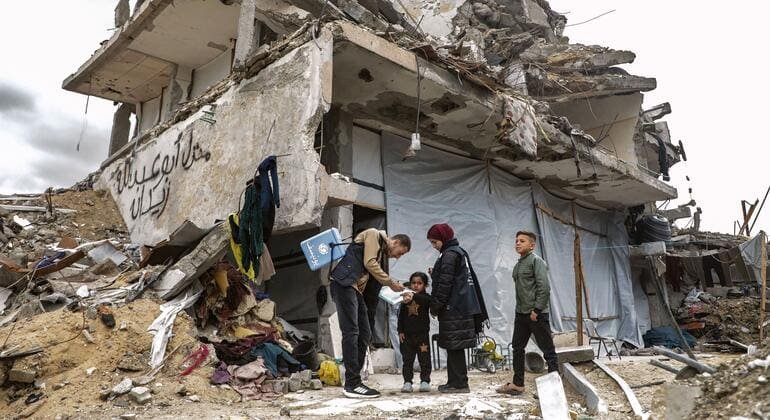
Earlier on Friday, Israeli forces attacked a high-rise they claim was used to launch attacks against them, damaging nearby tents sheltering displaced people, according to initial information from the UN aid coordination office (OCHA).
“Our humanitarian colleagues report that in the north, people are simply exhausted; they can’t afford to move south, not only because displacement sites are overcrowded but also because transport can cost up to $1,000,” Mr. Dujarric stated, noting that nearly 41,000 people have been displaced from Gaza City since 14 August.
‘Catastrophe Israel could have prevented’: WHO chief
Pointing out that the offensive is running alongside the spread of famine, World Health Organization (WHO) chief Tedros Adhanom Ghebreyesus said it was “a catastrophe that Israel could have prevented and could stop at any time.”
Starvation ‘will not make Israel safer’
“Starvation of civilians as a method of war is a war crime that can never be tolerated. Doing so in one conflict risks legitimizing its use in future conflicts.”
Since the conflict began in October 2023, at least 370 people have died from malnutrition in Gaza, including more than 300 just in the past two months, according to the UN health agency, which said the lack of food and clean water and cramped living conditions are weakening people’s immune systems.
It’s also exposing the population to more diseases, with more than 100 cases of Guillain-Barré Syndrome, including 11 deaths, reported in the last month.
“The most intolerable part of this man-made disaster is that it could be stopped right now,” he stated.
“People are starving to death while the food that could save them sits on trucks a short distance away. And for what? The starvation of the people of Gaza will not make Israel safer, nor will it facilitate the release of the hostages.”
While WHO is doing its best to alleviate suffering in Gaza, supporting medical evacuations of over 7,640 patients, more than 15,000 others need urgent specialized care, including 3,800 children.
More than 700 people have died while waiting for evacuations, Tedros said, urging countries to “open their arms to these critically ill patients” and calling on Israel to allow people to be treated in the nearby West Bank









Leave a Reply