



Strasbourg (dpa) – The EU Commission is suspending its support for Israel due to the country’s actions in the Gaza Strip. Commission President Ursula von der Leyen announced in the European Parliament that all related payments will be halted, although collaboration with Israeli civil society and the Holocaust memorial Yad Vashem will remain unaffected.
Originally, the Commission had intended to allocate an average of six million euros annually from an EU fund for international cooperation until the end of 2027. However, these funds will no longer be disbursed as per the new restrictions. Additionally, 14 million euros designated for ongoing projects will also be frozen. Israel responded critically, stating that the EU Commission’s decision is influenced by Hamas propaganda.
Further sanctions in the works
Von der Leyen mentioned plans to propose sanctions against extremist ministers and aggressive settlers to the member states, alongside recommending the suspension of trade agreements within the partnership framework.
“I know it will be challenging to garner majorities for these measures,” she remarked during her first state-of-the-EU address in her second term. Different member states have varying perspectives, with some considering these measures excessive and others deeming them insufficient. “However, we all must fulfill our responsibilities – Parliament, Council, and Commission.”
Conservative German MEP Hildegard Bentele expressed her “shock at the one-sidedness” of von der Leyen’s proposals, criticizing the lack of a strong stance against Hamas and concerns regarding humanitarian aid. She highlighted that the association agreement is being compromised without a plan for future dialogue with Israel, a situation detrimental to EU-Israel relations.
Israel: “This is not acceptable behavior between partners”
Israel’s Foreign Minister Gideon Saar criticized the decision, asserting that the EU Commission President is capitulating to pressures that aim to undermine Israel’s relations with Europe, which ultimately harms European interests. He stated that the EU Commission is inadvertently bolstering Hamas, which is responsible for the ongoing conflict in Gaza. “Above all: This is not acceptable behavior between partners,” Saar added.
EU countries divided in dealing with Israel
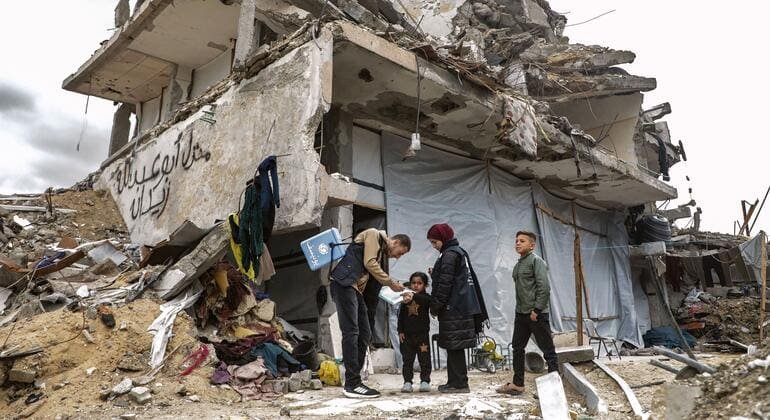
The EU is experiencing significant division regarding its approach to Israel. Member countries have yet to reach a consensus on the proposed measures from Brussels. In late July, the Commission recommended suspending cooperation under the Horizon Europe research funding program to exert pressure on Israel for improved humanitarian access in the besieged Gaza Strip, where hostilities with Hamas persist. Israeli firms could potentially lose access to substantial grants due to these sanctions.
The justification for these measures cites Israel’s violations of human rights and humanitarian international law amidst the humanitarian crisis in Gaza, breaching a fundamental principle of the EU-Israel association agreement.
Berlin does not want to agree to EU-Israel sanctions
Germany has voiced its opposition to the sanctions, while other countries like Spain have shown confusion over this rejection. The implementation of the EU Commission’s sanctions proposal requires backing from a qualified majority in the Council of Member States.
Specifically, 15 out of 27 EU countries must support it, representing at least 65 percent of the population of the involved member states. Recently, the only missing support came from Germany or Italy, with the majority of major and several smaller EU countries favoring the sanctions. (September 10)







Leave a Reply