


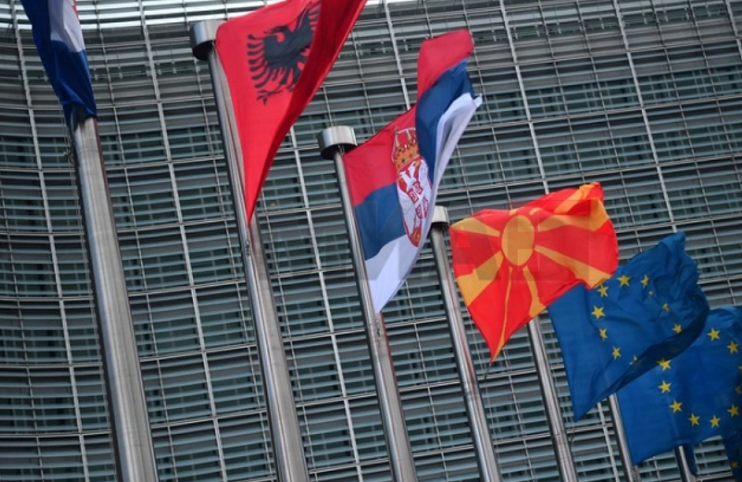
Vienna – Austria’s European Minister Claudia Plakolm (ÖVP) is advocating for a faster pace in EU enlargement, emphasizing the need for concrete actions for the people in the Western Balkans. In an interview with APA, she expressed optimism that the EU could welcome its first candidate countries “within a few years,” definitely by 2030. She stressed that, in response to US President Donald Trump’s aggressive tariff policies, Europe must take decisive action rather than remain passive.
“No progress in the Western Balkans for more than 20 years”
Plakolm criticized the lack of significant progress in the Western Balkans over the past two decades, citing neighboring countries as obstructive. She suggested reconsidering veto powers within the EU to facilitate quicker advances, proposing that it might be wiser to expedite certain steps before reverting to consensus decisions at the end of the process. “However, I believe it is crucial to achieve unanimity and dialogue on key issues,” she stated.
The European Minister warned that the EU risks losing credibility in the Western Balkans. “If we neglect European integration, there’s a real danger that the Western Balkans will fall under the influence of other geopolitical powers,” she noted, referencing the growing influence of nations like Russia and China. She highlighted a growing readiness for reform among the populace, especially youth, as evidenced by recent protests in Serbia, which demand tangible improvements and European integration.
Plakolm proposed that advanced candidate countries should be allowed to engage in EU initiatives as part of a “gradual integration” process. This could enhance economic cooperation with direct benefits for both the population and businesses in the region, accompanied by corresponding obligations. She identified Montenegro, North Macedonia, and Albania as the most promising candidates for EU membership. When asked if accession for these countries by 2030 is realistic, Plakolm replied, “Hopefully, I would wish for that.”
“Western Balkans are significantly more advanced than Ukraine”
Plakolm characterized Ukraine’s candidate status as a geopolitical decision, reaffirming Austria and the EU’s commitment to support Ukraine following the Russian invasion on February 24, 2022. While acknowledging the importance of aligning with European values, she cautioned that even if hostilities cease swiftly, Ukraine will not join the EU immediately. She pointed out that the integration process can take over 20 years for some nations, asserting that in this regard, the Western Balkans are significantly ahead of Ukraine.
Regarding the prospect of Canada’s EU membership, as suggested by former German Foreign Minister Sigmar Gabriel in opposition to Trump’s policies, Plakolm stated there are already enough candidate countries awaiting accession. However, she acknowledged the importance of strengthening international partnerships, particularly in relation to Canada.
“Europe must assert itself amidst geopolitical challenges”
Highlighting the need for European self-confidence amidst global tensions, Plakolm urged Europe not to retreat but to focus on strategic sovereignty. She likened Europe to an “old ship” adrift in the sea, suggesting that it should actively adjust its sails to navigate effectively rather than merely waiting for favorable winds.
On the topic of the EU’s proposed trade agreement with the Mercosur countries of South America, Plakolm, who recently joined discussions with Mercosur-critical EU member states, called for further dialogue. She emphasized that Austria, facing a significant budget deficit, advocates for a cautious EU budget that prioritizes essential issues such as security, defense, and migration. She sees potential for efficiency and savings within the EU’s financial framework.
Austria’s position as a net contributor to the EU budget remains firm, with Plakolm emphasizing the need for responsible management of EU resources. While discussing potential support for the European air defense initiative Sky Shield, she stated, “Such initiatives can certainly be considered.”
“Dialogue with Hungary is essential”
Plakolm refrained from criticizing Hungary’s blocking tactics within the EU, emphasizing that dialogue is the foundation of Europe’s strength. When asked about Prime Minister Viktor Orbán’s anti-EU rhetoric, she made it clear she finds it unacceptable but believes that dialogue is crucial for resolving such issues. Hungary’s intention to withdraw from the International Criminal Court (ICC) is its choice, she noted, paralleling the decisions made by other large democracies like the USA and Israel.
Stronger regulations for digital platforms are necessary
On the subject of large digital platforms like TikTok, Plakolm called for stricter EU regulations. She advocated for





Leave a Reply