


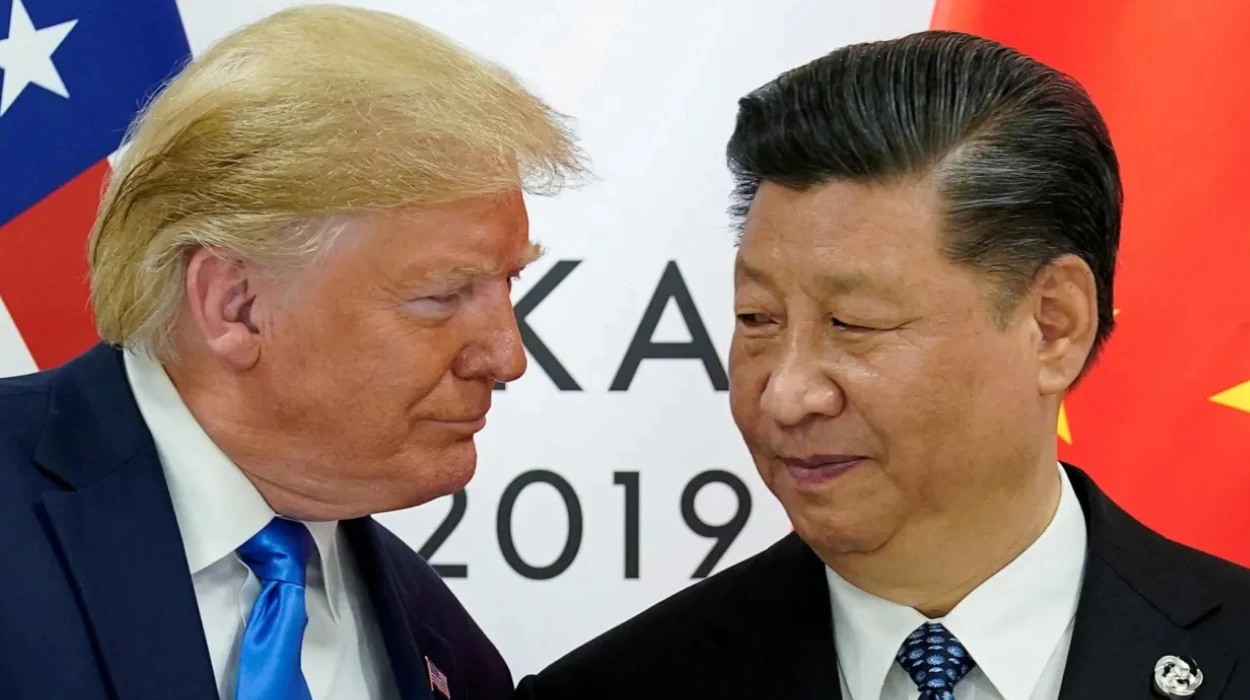
A mounting global economic confrontation has emerged between the United States and China, marked by reciprocal tariffs and retaliatory trade policies. This standoff began during President Donald Trump’s first term and carried through into his second, creating widespread disruptions in global trade, escalating economic uncertainty, and straining diplomatic relations between the two largest economies.
The Spark That Ignited the Inferno
The trade war escalated sharply on April 2, 2025, when President Donald Trump, following his return to office, implemented a new set of 34% tariffs targeting Chinese imports. This latest measure compounded earlier 20% tariffs from earlier in the year, resulting in a combined 54% levy on Chinese goods. Trump framed the move as a necessary step to redress trade imbalances, but critics labeled it a reckless gamble with global consequences.
China responded with equal force. Just two days later, Beijing countered with a matching 34% tariff on American imports, while limiting exports of rare earth minerals vital to technological and defense industries. China’s Ministry of Finance accused Washington of “economic terrorism” and pledged to protect national interests by all means. Additionally, Beijing blacklisted 11 U.S. firms tied to Taiwan and sharply restricted their economic engagement in China.
The Tariff Tidal Wave: Who Pays the Price?
As of April 5, the U.S. activated a sweeping 10% base tariff on all imported goods—excluding those from Canada and Mexico, due to ongoing fentanyl negotiations. Countries such as China, Vietnam, Taiwan, and members of the European Union were hit with the full 54% tariff rate following the recalibrated U.S. trade policy. Analysts cautioned that these measures could prove economically disastrous: The Federal Reserve projected a 15% inflation spike in consumer prices by the end of 2025, while JP Morgan revised its Q2 U.S. GDP forecast down to -10%, citing severe supply chain shocks.
China’s retaliatory actions were just as severe. Their blanket 34% tariff threatens approximately $143 billion worth of U.S. annual exports. Beijing’s restrictions on rare earth minerals—specifically dysprosium and terbium—pose serious risks to sectors such as semiconductors, electric vehicles, and advanced weaponry systems.
Citi analysts predict China’s GDP could shrink by 2.4% as the country scrambles to secure alternative agricultural sources like Brazilian soybeans and shifts manufacturing to Southeast Asian countries.
Sectoral Carnage: From Farmlands to Factories
America’s agricultural heartland has been hit particularly hard. China’s trade restrictions have essentially cut U.S. soybean farmers out of the market. With aggregate tariffs hovering near 50%, agricultural advocacy groups warn of widespread bankruptcies, especially across the Midwest. Grain surpluses remain in storage, while commodity futures prices for wheat and corn have declined by 22%.
Technological sectors face a critical threat as China controls over 85% of global rare earth refinement. This monopoly is integral to the U.S. defense and tech industries. The Pentagon acknowledges no immediate alternatives are available to fill the gap. Apple estimates the price of an iPhone could reach $2,300, and Tesla anticipates production delays for its electric trucks. Meanwhile, the U.S. Department of Defense is urgently stockpiling essential materials for advanced military systems like the F-35 and hypersonic missiles.
For everyday consumers, the trade war is hitting home. E-commerce platforms Temu and Shein lost their $800 duty-free exemptions, resulting in 30–50% import duties on inexpensive Chinese goods. Retailers warn that prices for everyday essentials—including clothing, electronics, and furniture—will rise by 15–20% this summer. Walmart CEO Doug McMillon criticized the tariffs as overreaching measures that unfairly burden working-class families.
Economic Impact and Global Repercussions: Focus on China
China’s economic challenges have deepened beyond U.S.-China trade alone. The trade war has exacerbated existing vulnerabilities in China’s economy, including declining GDP growth, deflationary pressures, and structural financial imbalances. Together with geopolitical strains, these issues jeopardize China’s long-term economic trajectory.
Impact on China’s GDP and Trade
Washington’s tariff increases have disrupted China’s export-dependent growth model. Proposals to










Leave a Reply