


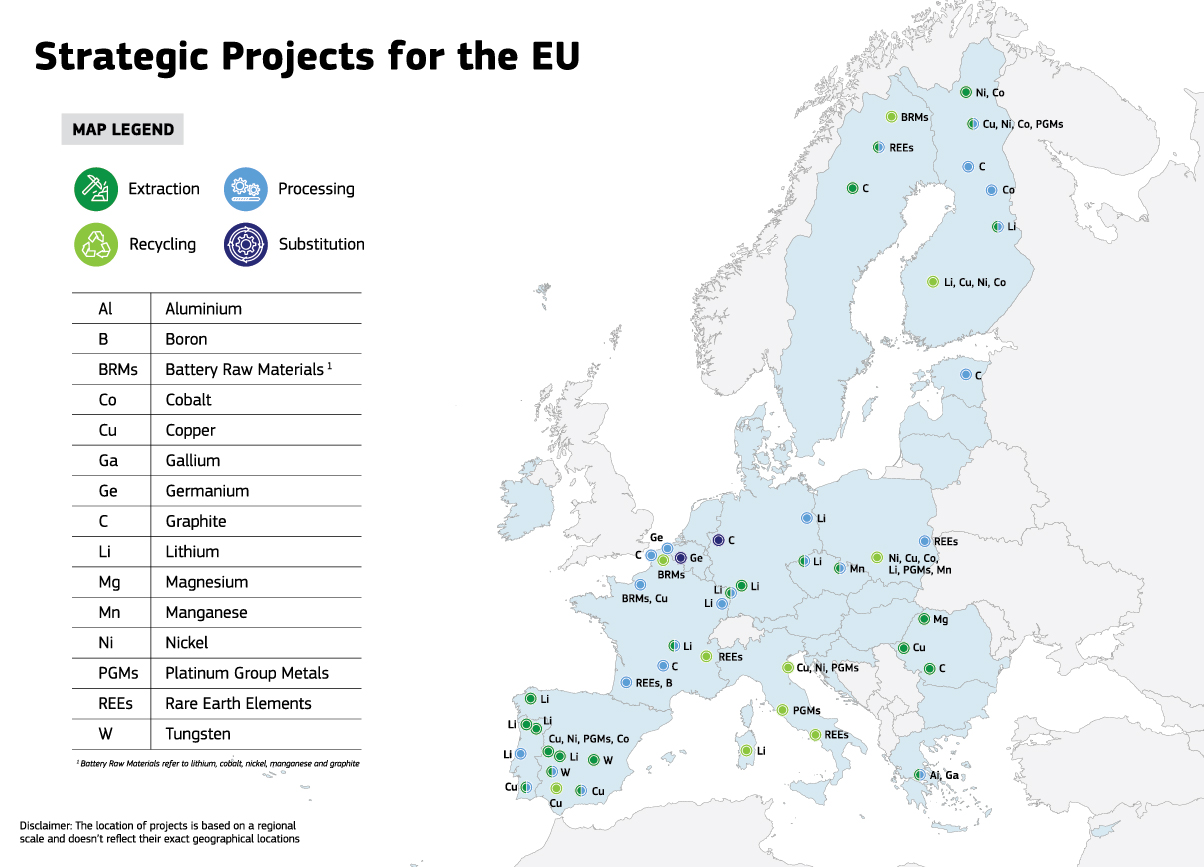
Today, the European Commission announced the approval of 47 strategic projects focused on the mining, processing, and recycling of rare earths and raw materials across Europe. This initiative aims to decrease reliance on third-party countries and diversify the sources of supply.
These 47 projects span 13 EU member states: Greece, Belgium, France, Italy, Germany, Spain, Estonia, the Czech Republic, Sweden, Finland, Portugal, Poland, and Romania.
The projects target 14 of the 17 strategic metals identified in the Critical Raw Materials Act (CRMA), which took effect in May 2024. This legislation sets ambitious targets for the EU to meet by 2030, including fulfilling at least 10% of its mining needs, 40% of processing requirements, and 25% of recycling needs for each metal. Additionally, the EU aims to ensure that no more than 65% of its strategic raw material requirements are sourced from any single third country.
Highlighting a Greek Initiative
One notable inclusion on the Commission’s list is a project from Greece. Proposed by “Metlen Energy and Metals and European Bauxites,” it focuses on the mining and processing of bauxite, alumina, and gallium. This is the sole project in the EU’s approval list dedicated to these specific metals.
The Commission stated that these 47 projects were chosen for their potential to ensure a secure supply of strategic raw materials, align with environmental and social criteria, and demonstrate technical viability.
The total capital investment required for these strategic projects is estimated at 22.5 billion euros. They will receive coordinated support from the Commission, member states, and financial institutions to facilitate their launch, particularly through funding access and community engagement. Additionally, these projects will enjoy streamlined licensing processes; under the CRMA, mining project licenses are expected to take no longer than 27 months, while other projects should take no more than 15 months—vastly shorter than the current five to ten-year timelines.
“Europe currently depends on third countries for a significant portion of the raw materials it requires. We must enhance our domestic production, diversify our external supplies, and establish stockpiles,” stated Stéphane Séjourné, the Commission’s Executive Vice-President for Industrial Strategy. “This is a pivotal moment for Europe’s sovereignty as an industrial force,” he added.
Lastly, the Commission has received applications for “strategic projects” located in third countries, and a decision on their potential selection will be made in due course. (25/3/2025)
Source of the graph: European Commission







Leave a Reply