


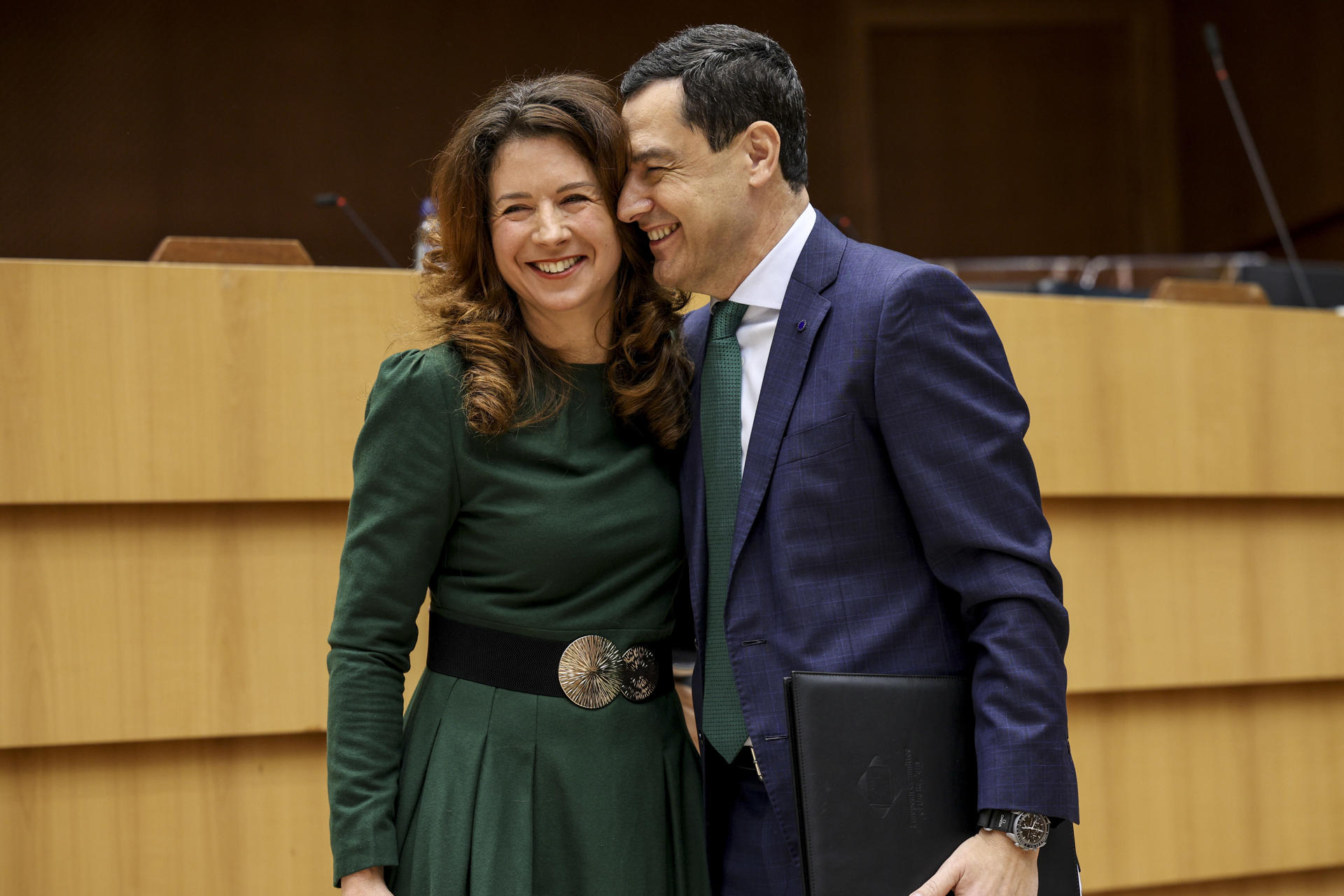
Brussels – The election of Juanma Moreno, head of the Andalusian government, to co-chair the European Committee of the Regions alongside Hungary’s Kata Tutto marks a significant milestone for him, positioning him prominently within European institutions at a pivotal time for future policy development.
Here are some important highlights of Moreno’s new role within the European Committee of the Regions:
A Long-Standing Ambition for Europe
The Andalusian president has consistently viewed a presence in Brussels and European institutions as a vital goal. His frequent trips to the Belgian capital reflect his belief that essential policies impacting regions, particularly concerning substantial fund allocations, are formulated there.
Since taking office, Moreno has sought to reclaim the European influence he perceived as “lost,” emphasizing that 70% of competences are connected to European directives. He remarked, “It’s a matter of spaces; either Andalusia takes its rightful place as a leading region, or someone else will fill that void.” Following his initial official visit to Brussels in 2019, he asserted this week that Andalusia “is the most influential community in the EU.”
Increased Influence
This election enhances Moreno’s influence within European institutions, an impact he claims he has already begun to witness prior to his formal appointment. His new position will facilitate meetings with key EU commissioners, including the President of the European Commission, Ursula von der Leyen.
During this visit, he engaged with various leaders such as the President of the European Council, former Portuguese Prime Minister Antonio Costa, and met with European Commissioner for Sustainable Transport and Tourism Apostolos Tzitzikostas, Vice-President for Cohesion and Reforms Raffaele Fitto, and Commissioner for Energy and Housing Dan Jorgensen.
Addressing Major Challenges
In his inaugural speech post-election, Moreno tackled significant European challenges that extend beyond regional policies. He addressed issues such as ongoing military conflicts, the “uncertainty” surrounding US-EU relations, and the global order.
Moreno advocated for a well-regulated migration policy, decentralized cohesion strategies, reinforced democracy, and robust climate change initiatives. Speaking in the European Parliament’s hemicycle during a plenary session, he appeared at ease and engaged in the pressing debates facing the EU.
A Pro-European Stance Against Populism
Moreno’s address championed pro-European ideals, countering “disinformation” and the “voices” he believes threaten to undermine a project he views as having achieved decades of “success.”
He expressed concern regarding the rise of “emerging” populisms, underscoring the importance of European unity and identity while calling for a concerted effort against “growing anti-European sentiments.” Moreno aims to reinforce a sense of “pride in European identity” against a “disinformation machine” that he claims attempts to destabilize and disband the EU.
Collaboration Between Parties
The shared presidency model between Moreno and socialist Kata Tutto represents a rare collaboration amid a period marked by party discord. Moreno conceded that while dialogue is more feasible in Europe, it currently appears unlikely in Spain, attributing this to Prime Minister Pedro Sánchez.
The “co-presidency,” initially under Tutto’s leadership and transitioning to Moreno in two and a half years, is intended to transcend ideological divides for the sake of their “common goals.” Moreno views this as the introduction of the “Andalusian way” to Europe, a phrase he has coined to express his commitment to collaboration over political contention. (February 20)








Leave a Reply